
Corporate Event AV Mistakes: 2026 Risk Mitigation Guide
Imagine your keynote speaker stepping onto the stage only for a piercing screech of feedback to drown out their first sentence. You look to the sound booth, but the audio tech points at the venue manager, who is already gesturing toward the lighting crew. This cycle of finger-pointing is one of the most common corporate event AV mistakes, and it often stems from a fragmented production model rather than a gear failure. It's an exhausting experience that leaves you managing the friction between vendors instead of focusing on your guests.
You deserve the peace of mind that comes from a technical execution where every moving part works in harmony. We understand that the rising costs of labor and equipment in 2026 make the stakes higher than ever. This guide will teach you how to identify and eliminate logistical errors by adopting a unified production strategy. We'll explore how a single point of contact reduces administrative burdens and ensures predictable pricing, giving you a clear roadmap to a seamless, glitch-free event.
Table of Contents
Common Corporate Event AV Mistakes: The Cost of Fragmentation
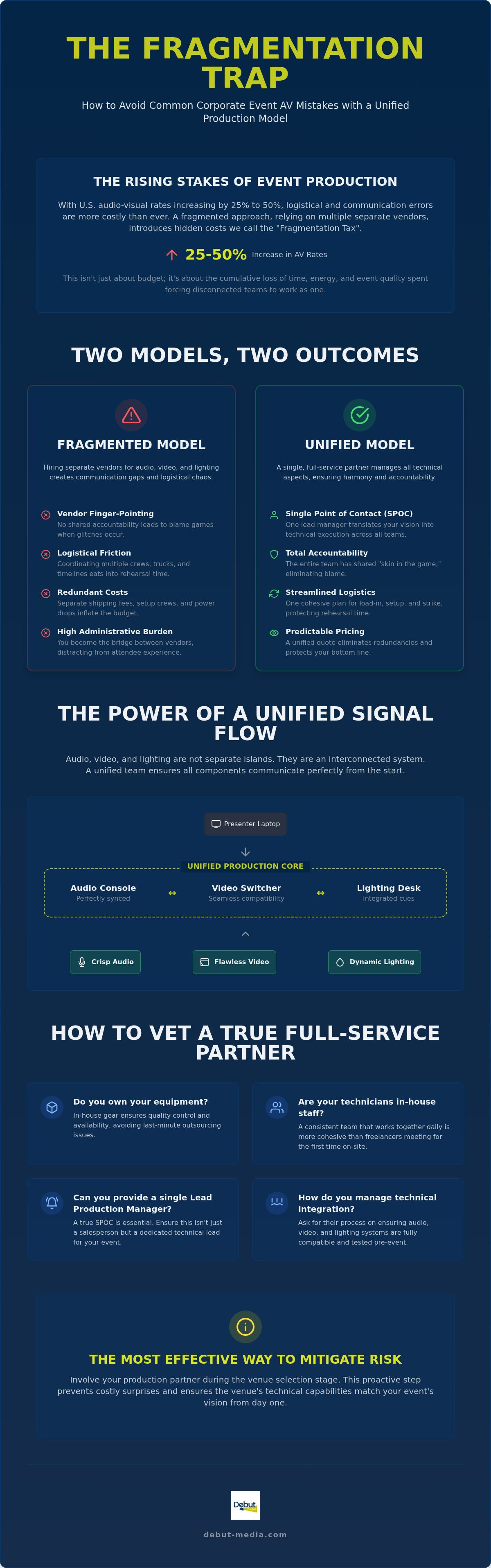
When you hire separate vendors for audio, lighting, and video, you often encounter what we call the "Fragmentation Tax." This isn't a line item on an invoice; it's the cumulative loss of time and budget spent trying to force disconnected teams to work as one. Many common corporate event AV mistakes aren't actually technical failures. They are communication failures that occur when specialized teams operate in isolation.
Fragmentation creates "The Gap," a dangerous zone where critical tasks overlap or, worse, disappear entirely. For instance, who is responsible for the signal converter between the presenter's laptop and the LED wall? If both the video team and the computer technician assume the other has it, your presentation stops before it starts. This lack of a unified signal flow is a hallmark of fragmented planning, turning minor oversights into event-halting crises.
Beyond the technical risks, there's a significant financial reality. Fragmented models involve multiple shipping fees, separate setup crews, and redundant power drops. With U.S. audio-visual rates having increased by 25% to 50% since the pandemic, you can't afford the waste of fragmented logistics. Comprehensive live event technical support requires a unified approach to eliminate these redundancies and protect your bottom line.
The mental load on a planner is equally taxing. Managing five different communication chains instead of one creates a constant state of high alert. You become the human bridge between vendors who should already be integrated. This administrative burden distracts you from your primary goal: ensuring your attendees and stakeholders have a meaningful experience.
The Risk of Vendor Finger-Pointing
We've all seen the scenario. A signal glitch occurs during a keynote, and the audio team blames the video feed while the lighting crew stays silent. In a multi-vendor environment, there's no shared skin in the game. Each team is only responsible for their specific "silo," which leads to a critical lack of shared accountability. Accountability is the essential framework for event production success, serving as the guarantee that every technical detail has a dedicated owner.
Logistical Friction in Large-Scale Productions
Coordinating load-in and load-out schedules for five different companies is a logistical nightmare. Each vendor has their own truck, their own crew lead, and their own timeline. This friction eats into your rehearsal time and often pushes the final soundcheck to the very last minute. Learning how to go about reducing event logistical friction starts at the vendor selection stage. When one team manages the entire floor, the timeline becomes a cohesive plan rather than a series of compromises, ensuring every rehearsal stays on track.
Technical Failures: Why Your Audio-Visual Signal Flow Needs a Unified Team
One of the most common corporate event AV mistakes is viewing audio, video, and lighting as separate islands. In reality, they are interconnected streams in a single signal flow. If the video switcher doesn't communicate perfectly with the audio console, your high-definition video won't have the sound to match. This fragmentation often leads to compatibility issues that aren't discovered until the first rehearsal, when time is already running out.
A unified team acts as a management layer that bridges these technical gaps. When specialists work for the same organization, they follow a standardized quality control process. They know exactly how their hardware interacts because it lives in the same warehouse and travels on the same truck. This level of technical cohesion is impossible to achieve when patching together independent contractors who are meeting for the first time on-site. It's the difference between a collection of parts and a high-performance machine.
The Stabilizing Force of a Lead Production Manager
Effective event production requires a Single Point of Contact (SPOC) who understands the big picture. This lead manager acts as a steady hand, translating your high-level corporate goals into specific technical requirements. Without this role, you're forced to play a high-stakes game of "telephone" between multiple department heads. A dedicated production manager ensures that your keynote speaker's requirements are met across all disciplines simultaneously. If you're feeling overwhelmed by these technical layers, partnering with a professional resource like Debut Media provides the expert oversight needed for a flawless execution.
Integrated Technical Disciplines
Integrated teams share more than just equipment; they share a communication culture. When the lighting designer knows exactly when the video team is transitioning to a dark-screen presentation, they can pre-program cues that complement the visual shift. This synchronization prevents the awkward "dead air" or jarring transitions that often plague multi-vendor shows. Additionally, unified teams are far more efficient during equipment strikes and load-outs. They don't fight for dock space or power drops because they've already planned a coordinated exit. This level of integration allows the team to handle last-minute script changes with ease, as a single update reaches every technician instantly.
Single Vendor vs. Multi-Vendor Models: A Strategic Comparison
Choosing between a single production partner and a multi-vendor lineup is a strategic decision that dictates your event's ultimate stress level. Many common corporate event AV mistakes originate in the procurement phase, where planners inadvertently trade reliability for perceived flexibility. While a multi-vendor model might appear manageable on paper, it often hides "invisible costs" such as administrative overhead and technical redundancies. Managing fifteen disconnected email threads instead of one consolidated channel creates a communication vacuum where vital details are easily lost.
A consolidated model ensures total budget transparency. Instead of juggling several variable invoices with hidden fees, you receive one comprehensive quote. This approach eliminates the surprise surcharges often associated with uncoordinated labor hours or redundant equipment shipping. In a unified system, every piece of gear is chosen to complement the next, creating a technical cohesion that patched-together systems simply cannot match. This integrated signal flow is the foundation of a glitch-free performance.
Efficiency in the Planning Phase
Managing a single partner significantly accelerates your pre-event timeline. Site visits and venue walkthroughs become singular, focused sessions rather than repeated tours for different teams. Technical drawings are also more accurate because they're produced by a unified design department that understands exactly how lighting rigs and audio arrays interact in the physical space. By streamlining the corporate event production process, you move from a reactive posture to a proactive one. You spend less time in status updates and more time refining your event's core message.
Reliability During Live Execution
The true value of a unified team emerges during the high-stakes moments of live execution. If a technical issue arises, troubleshooting happens in seconds because every technician on-site reports to one lead. There's no debate over vendor boundaries or responsibility. This expert oversight is especially critical during complex transitions, such as turning a daytime seminar space into a branded evening gala. A unified crew coordinates the equipment strike and reset as a single unit, ensuring the doors open exactly on time. This "Calm Factor" provides the emotional relief you need, knowing a seasoned fixer is managing the entire technical landscape with a steady hand.
How to Vet a Full-Service Production Partner for Reliability
Selecting a production partner is a high-stakes decision that determines whether your event feels like a cohesive brand experience or a series of technical hurdles. Avoiding common corporate event AV mistakes requires a rigorous vetting process that looks beyond a flashy equipment list. You need to verify that your partner has the internal infrastructure to support your vision rather than just a network of subcontractors. Use the following framework to evaluate potential partners.
Step 1: Verify in-house capabilities. Ask directly if they own their gear and employ their technicians. Firms that "white label" or outsource services often struggle with the technical cohesion mentioned in previous sections.
Step 2: Assess format-specific experience. A team that excels at small seminars might lack the logistical depth required for a 1,000-person gala or a complex trade show.
Step 3: Review national logistical credentials. Ensure they have a proven track record of managing equipment transport and crew travel across state lines without missing load-in windows.
Step 4: Evaluate strike protocols. Efficiency on the back end is just as important as the setup. Ask how they manage the equipment strike to ensure the venue is cleared on schedule.
Step 5: Check for a "fixer" mentality. Ask for a specific example of a time they averted a technical disaster. You want a partner who remains calm and has a plan for every "what-if" scenario.
Critical Questions for the AV Team
When interviewing a potential team, go deeper than surface-level promises. Ask: "Do your audio and video leads work together regularly or are they freelancers meeting for the first time?" This reveals the level of technical synergy you can expect. Inquire about how they handle on-site event technical operation when a primary signal fails. A reliable partner provides honest guidance and maintains an unshakeable calm, even when the pressure is at its peak. If you are looking for this level of stability, partner with a seasoned fixer for your next event.
Reviewing Trade Show and Expo Specifics
For exhibitors and expo organizers, the complexity of common corporate event AV mistakes shifts toward booth-specific technical needs. Ensure your partner understands trade show logistical support and the specific rules governing exhibit halls, such as drayage and union labor requirements. A true full-service partner should provide specialized lighting and graphic design for booths in-house. This allows you to manage multi-exhibitor needs through a single contact, eliminating the friction of coordinating with dozens of individual booth vendors.
Implementing a Unified Production Model for Your Next Event
Transitioning to a unified production model is a strategic pivot that moves you from managing vendors to leading an event. To begin this shift, your RFP process must change. Instead of requesting separate bids for audio, lighting, and management, consolidate these requirements into a single, comprehensive document. This approach forces vendors to demonstrate how they will integrate these disciplines rather than just listing gear. It is the most effective way to prevent common corporate event AV mistakes that arise when disconnected teams are expected to synchronize on-site without a shared roadmap.
Involving your production partner during the venue selection process is another critical step. A seasoned fixer can identify hidden technical hurdles, such as inadequate power distribution or restrictive rigging points, before you sign a contract. In-house AV clauses at many venues can inflate your budget by 30% to 50% through "patch fees" and surcharges. By bringing Debut Media into the conversation early, you gain a turnkey proposal that covers AV, management, and logistics with total transparency. This foresight ensures your technical vision is feasible and protects your budget from unexpected venue costs.
The First 30 Days of Unified Planning
The first month of a unified partnership is about establishing a stabilizing plan to reduce project noise. We immediately create a single communication channel, replacing the chaotic web of vendor emails with one clear line of accountability. During this phase, our in-house specialists integrate graphic design and branding into the production schedule. This early collaboration ensures that your visual content is optimized for the specific LED walls or projection systems being used, maintaining brand cohesion across every screen and booth.
Seamless Execution from Load-In to Strike
When the live event begins, the relief of having a steady hand on-site is transformative. You no longer need to mediate between technical departments because every specialist reports to one lead technician who understands your goals. This unified oversight ensures that the transition from a daytime seminar to an evening gala happens with precision and speed. If you are ready to eliminate logistical friction and technical errors, it's time to move toward a more integrated production strategy. Debut Media positions itself as your dedicated fixer, committed to a long-term partnership that prioritizes your peace of mind and your event's success.
Achieving Technical Excellence through Unified Production
The complexity of 2026 event production demands a move away from fragmented vendor management. By consolidating technical disciplines under a single management layer, you eliminate the communication gaps that lead to common corporate event AV mistakes. This strategic shift ensures that audio, lighting, and video work as a synchronized system rather than isolated silos. You gain more than just technical reliability; you gain the emotional relief of knowing a single partner is accountable for every signal and stage cue.
Our in-house team of AV, lighting, and design specialists provides turnkey solutions for seminars, conferences, and galas. This integrated approach eliminates logistical friction and provides the expert oversight necessary for high-stakes environments. You don't have to navigate complex technical hurdles alone when you have a dedicated partner handling the moving parts.
Simplify your next corporate event with Debut Media’s unified production team. We are ready to act as your seasoned fixer, ensuring your next production is seamless, professional, and entirely stress-free.
Frequently Asked Questions
What are the most common corporate event AV mistakes planners make?
The most common corporate event AV mistakes involve fragmented planning and a lack of unified accountability. Planners often hire separate vendors for sound, lighting, and video, which leads to gaps where technical responsibilities overlap or fall through. This fragmentation causes vendor finger-pointing during glitches and creates hidden administrative costs. Adopting a single point of contact model ensures every technical detail is managed by a cohesive team with shared goals.
What exactly does a single point of contact (SPOC) event production partner do?
A single point of contact production partner acts as a master coordinator for all technical and logistical moving parts. This lead manager translates your corporate objectives into specific technical requirements for audio, video, and lighting teams. Instead of you managing fifteen separate email threads, the SPOC handles the communication between specialists. They provide expert oversight from the initial site visit through the final equipment strike, acting as a stabilizing force.
Is it more expensive to hire one full-service production company than multiple specialists?
Hiring a full-service production company is often more cost-effective than managing multiple specialists. While individual line items might seem comparable, a unified model eliminates the "Fragmentation Tax" of redundant shipping fees and uncoordinated labor hours. You receive a comprehensive quote with predictable pricing rather than several variable invoices. This approach also reduces venue surcharges by involving technical experts early in the planning process to identify hurdles before they become expensive.
How does a single point of contact improve the quality of audio-visual services?
Quality improves because a unified team manages the entire signal flow as an integrated system rather than isolated silos. When audio, video, and lighting specialists share the same warehouse and culture, they use hardware that is specifically tested for compatibility. This integration prevents signal interference and ensures smoother transitions during your live event. Standardized quality control protocols replace the patched-together systems that often result from using multiple disconnected providers.
Can a SPOC partner handle both small seminars and large-scale corporate galas?
Yes, a professional production partner provides turnkey solutions for events of all scales, from intimate seminars to large-scale national galas. The single point of contact model is designed to scale with your needs, ensuring the same level of reliability regardless of audience size. Whether you need a simple projector and screen rental or a complex multi-room conference setup, the focus remains on simplifying logistics and eliminating technical friction for the planning team.
What happens if the single point of contact is unavailable during the event?
A unified production model relies on an in-house team of specialists rather than a single individual. While you have one primary manager, the entire crew follows a standardized execution plan that is documented and shared. If a lead manager is pulled away, the lead technician or logistics coordinator steps in with full knowledge of the event's technical requirements. This redundant expertise ensures that your event production remains stable and supported throughout the entire schedule.
How does a unified production model affect event equipment strike services?
A unified production model significantly speeds up the equipment strike and venue load-out process. Because the entire crew reports to one lead, they coordinate their exit as a single unit rather than fighting for limited dock space or power drops. This efficiency ensures that the venue is cleared exactly on schedule, avoiding potential overtime fees. Coordinated strikes also mean that equipment is packed and transported more securely, reducing the risk of technical damage.
Does a single point of contact handle trade show and expo support as well?
Yes, a full-service production partner provides comprehensive trade show and expo support for both organizers and individual exhibitors. This includes specialized booth lighting, in-house graphic design for visual presence, and technical management for multi-exhibitor floors. Having a single contact for these needs eliminates the friction of coordinating with dozens of different booth vendors. It ensures that the entire expo floor maintains a consistent technical standard and professional appearance for all attendees.


