
The Myth of the Middleman: Why a Single Point of Contact is Vital for Turnkey Event Production in 2026
What if the greatest risk to your next conference isn't the technology itself, but the invisible gaps between the people running it? Many organizers believe that hiring separate specialists for audio visual services and event management ensures the best results, but this fragmentation often leads to a chaotic "blame game" when things go wrong on-site. By choosing comprehensive turnkey event production services, you replace a dozen potential points of failure with a single, synchronized team. This structure isn't just a convenience; it's a strategic safeguard against the communication breakdowns that derail high-stakes productions.
It's frustrating to deal with vendor fragmentation that results in overlapping delivery fees and technical glitches. You deserve a partnership where the right hand always knows what the left is doing. In this guide, you'll discover why consolidating your production under a single point of contact is the most reliable way to secure a flawless outcome in 2026. We will break down how this model eliminates logistical friction, provides predictable pricing, and ensures every integrated system works perfectly from the first sound check to the final teardown.
Table of Contents
Understanding Turnkey Event Production Services: More Than Just a Bundle
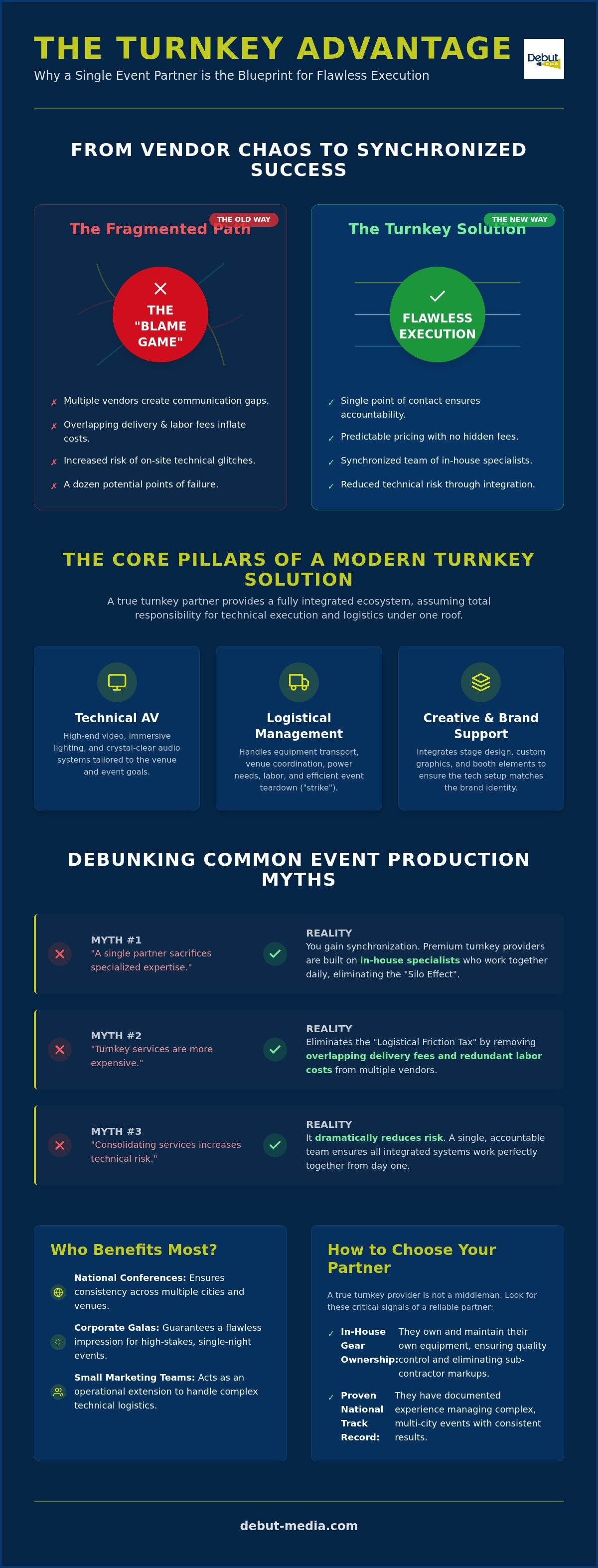
In the evolving landscape of 2026, the definition of turnkey event production services has shifted from a simple "package deal" to a fully integrated ecosystem. At its core, a turnkey solution is a comprehensive service model where a single partner assumes total responsibility for audio visual services, logistical planning, and technical execution. It's no longer enough to just deliver a truckload of gear to a venue. Today's corporate clients expect a synchronized operation where every moving part, from the LED wall's refresh rate to the timing of the keynote's walk-on music, is managed by a unified team.
The industry has moved decisively away from the era of "equipment rental." In the past, you might have sourced a projector from one company and a sound system from another. This fragmented approach created a "Logistical Friction Tax" that drained budgets and increased the risk of technical failure. Modern production is about integrated solutions. This means your production partner doesn't just provide tools; they provide the expertise to ensure those tools work together perfectly. However, the "turnkey" label is frequently misused. Many companies act as middlemen, sub-contracting every department to different third parties. A true turnkey provider maintains in-house control over their equipment and their crew, ensuring that accountability is never diluted.
A vital component of this model is the role of a corporate event logistics management specialist. This professional acts as the bridge between the technical crew and the venue's operational staff. They handle the invisible details that often cause the most stress, such as load-in schedules, power requirements, and labor union regulations. When logistics and production live under the same roof, the friction of coordinating multiple vendors simply disappears.
The Core Pillars of a Turnkey Solution
To provide a truly seamless experience, a production partner must master three distinct areas of expertise:
Technical AV: This includes high-end video projection, immersive lighting design, and crystal-clear sound systems tailored to the room's acoustics.
Logistical Management: Handling the heavy lifting of equipment transport, venue coordination, and the efficient "strike" or teardown of the event.
Creative Support: Integrating trade show booth designs and custom graphic elements so the technical setup matches the brand's visual identity.
Who Benefits Most from Turnkey Services?
While any event can be improved by better organization, certain scenarios make turnkey event production services an absolute necessity. National conferences that travel to multiple cities require a level of consistency that only a single, dedicated team can provide. Corporate galas also fall into this category; when you have one night to make a perfect impression, you can't afford the communication gaps inherent in a multi-vendor setup. Finally, small marketing teams often use turnkey providers as an "operational extension." This allows them to focus on content and strategy while a seasoned "fixer" handles the complex technical details of a large-scale expo.
Myth #1: 'A Single Point of Contact Sacrifices Specialized Expertise'
A common fear among event planners is that hiring one company for everything results in a "jack of all trades, master of none" scenario. They worry that by not hiring a boutique lighting firm or a niche audio shop, they're settling for mediocrity. This couldn't be further from the truth. In 2026, premium turnkey event production services are built on a foundation of in-house specialists who work together daily. You aren't losing expertise; you're gaining synchronization.
Think about the "Silo Effect." You could hire ten world-class specialists, but if they've never worked together, your event becomes a series of disconnected islands. The audio team doesn't care about the lighting cues, and the video tech doesn't know the stage manager's schedule. An event planning single point contact eliminates this friction by acting as the conductor for an entire orchestra of experts. They ensure that every department is pulling in the same direction, which is something a group of independent vendors simply cannot do.
The Reality of Integrated In-House Teams
When your production team is all under one roof, communication happens in real-time, not through endless email chains that get buried in your inbox. This integration allows for cross-training that separate vendors can't match. Your lighting lead understands the specific power requirements of the audio rack because they've worked the same circuit together for years. This level of internal coordination ensures your brand standards remain consistent across every screen, speaker, and printed banner in the room. It’s about creating a cohesive environment where the technology supports the message rather than distracting from it.
The Role of the Lead Technical Producer
Every successful production needs a "fixer." The lead technical producer is that steady hand who remains calm when the pressure rises during a live show. They don't just manage gear; they translate complex technical jargon into clear, actionable business decisions for you. Instead of hearing about bandwidth saturation or decibel peaking, you get a solution that keeps the show moving. Accountability is the ultimate benefit here. When one person is responsible for the entire technical ecosystem, there's no room for the blame game. If you want to see how a unified team can transform your next gala, consider how professional audio visual services can stabilize your entire planning process.
Myth #2: 'Turnkey Production Services are More Expensive Than DIY Vendor Sourcing'
Many event planners believe that by sourcing individual vendors for every technical niche, they're cutting out a "middleman" and saving money. This is often a false economy. While the initial line items on separate quotes might look smaller, they don't account for the Logistical Friction Tax. Integrated turnkey event production services actually lower costs by centralizing labor and eliminating the redundant fees that individual vendors must charge to remain profitable. You aren't just paying for gear; you're paying for the coordination required to keep those vendors from clashing on-site.
Managing five different contracts doesn't just double your paperwork; it significantly increases the risks of multiple event vendors. When you hire separate entities, you lose the ability to bundle services. Each independent company has its own overhead, its own profit margin, and its own minimum labor calls. By the time you add up the separate delivery fees and the extra hours spent on coordination, the "DIY" approach often exceeds the cost of a single, comprehensive partnership.
Analyzing the Hidden Costs of Fragmentation
When you hire separate crews, you're paying for multiple site visits and redundant travel expenses. Each vendor brings their own truck and their own insurance. There's also the invisible cost of "Technical Drift." This occurs when equipment from different providers doesn't sync perfectly, requiring expensive on-site troubleshooting to resolve compatibility issues. Administrative overhead is another drain on your budget. Processing fifteen separate invoices and verifying fifteen different insurance certificates takes your internal team away from high-value strategic planning.
Strategic Resource Optimization
A turnkey partner can repurpose labor across the entire show. A technician who helps set up the lighting can also support the audio strike. This cross-functional efficiency is impossible with independent contractors who only focus on their specific niche. Bundling essential equipment rentals like projectors and screens also allows for significant cost reduction. Because a true turnkey provider owns their entire inventory, they can offer package pricing that individual rental shops can't match. Finally, a single large contract gives you more negotiating power with the venue. One unified production team gets better cooperation and more efficient load-in times than five small, competing crews. This streamlined approach ensures your budget is spent on the attendee experience rather than unnecessary logistical hurdles.
Myth #3: 'Consolidating Services Increases Technical Risk'
Many organizers hesitate to put all their eggs in one basket, fearing a single point of failure. They believe that by spreading the work across multiple vendors, they're creating a safety net. In practice, the opposite is true. Most technical failures don't stem from a piece of gear breaking; they stem from a breakdown in communication between two different companies. Turnkey event production services eliminate these "dead zones" by ensuring that every system is designed to work in harmony from the start. Centralization doesn't create a single point of failure; it creates a single point of absolute accountability.
Consider the "Vendor Blame Game." This is the nightmare scenario where a microphone cuts out and the audio lead blames frequency interference from the lighting rigs, while the lighting tech blames the venue's power supply. You're left standing in the middle of a silent room, trying to moderate a technical dispute you shouldn't have to understand. Centralization puts an end to this. When one team owns the entire technical stack, there's no one else to blame. The focus shifts immediately from finger-pointing to rapid resolution. The team works together to find the fix because they're all wearing the same logo.
Accountability as a Risk Mitigation Tool
Reliability comes from a "Buck Stops Here" philosophy. You have one phone call to make and one person who's empowered to solve any problem across any department. This model also allows for standardized equipment. When a single provider manages the show, they use gear they know is compatible. This reduces the risk of the "Technical Drift" mentioned earlier, where mismatched software or hardware versions cause unexpected glitches during the live show. An integrated team doesn't just plan for their own success; they plan for the success of the entire technical ecosystem.
Streamlining On-Site Execution
A successful on-site event technical operation depends on a master contingency plan that covers every department simultaneously. In a turnkey environment, the audio, video, and lighting teams are all on the same radio frequency and the same schedule. They aren't competing for space on the loading dock or power on the stage. This level of coordination ensures that if a projector fails, the video lead can immediately pull a backup from the shared inventory without needing to wait for an external delivery. If you're ready to secure this level of stability for your next event, explore our Audio Visual Services to see how we manage risk through integration.
Choosing Your Turnkey Partner: Transitioning to Flawless Execution
Selecting the right partner is the final hurdle in moving from a fragmented planning process to a streamlined execution. When you evaluate turnkey event production services, you must look beneath the surface of the marketing claims. A true partner doesn't just manage vendors; they own the process. This starts with verifying their in-house capabilities. Ask direct questions about their inventory and staff. Do they own the projectors and LED walls? Are the technicians on-site full-time employees or temporary local hires? Gear ownership and a dedicated crew are the only ways to guarantee the reliability and cost-efficiency discussed in previous sections.
National experience is another non-negotiable factor for corporate tours or multi-city seminars. A provider with a national reach understands the nuances of different venues and local labor regulations, which prevents the logistical friction from creeping back into your budget. Beyond technical specs, look for the "Stabilizer" factor. Your production partner should feel like a seasoned fixer who remains calm when timelines shift. At Debut Media, we focus on this emotional relief, providing a single point of contact who translates your vision into a flawless technical reality. We replace the chaos of multiple email chains with one steady hand that guides the entire production.
Essential Criteria for an Event Production Partner
Before signing a contract, ensure your provider has a proven track record in high-stakes environments like galas and national conferences. These events leave no room for technical errors. Your partner should also demonstrate an ability to handle specialized needs, such as providing comprehensive trade show logistical support. This includes everything from booth integration to complex power drops and rigging. Finally, insist on transparent pricing models. A professional turnkey partner provides a detailed breakdown that eliminates surprise additions on show-site, ensuring your budget stays predictable from start to finish. In 2026, events are viewed as strategic investments, so your partner must deliver measurable outcomes and high ROI.
The Final Step: From Planning to Peace of Mind
The transition from a signed proposal to a live event begins with a comprehensive kickoff meeting. This is where your single point of contact aligns every department, including audio, video, and management, with your specific goals. You should set clear KPIs for technical performance and logistical efficiency to ensure accountability throughout the project. This organized approach replaces the stress of vendor management with the peace of mind that comes from expert oversight. If you are ready to simplify your next production and eliminate the gaps in your planning, contact Debut Media for a turnkey production quote today. We are ready to act as the stabilizing force your event deserves.
Securing Seamless Success for Your 2026 Events
Transitioning to a unified model is the most effective way to protect your event from the hidden risks of vendor fragmentation. We've seen how integrating audio, video, and logistics under one roof doesn't just save money; it creates a safety net of absolute accountability. By choosing true turnkey event production services, you ensure that every specialist on-site is working toward a singular vision rather than protecting their own niche. This strategic shift replaces the common "blame game" with proactive problem-solving and technical precision across every department.
You don't have to manage the complexity of modern production alone. Our in-house specialists provide national service coverage for conferences, galas, and trade shows, acting as a stabilizing force for your entire team. You can stop worrying about the invisible gaps between vendors and start focusing on the impact of your message. Streamline your next event with Debut Media’s turnkey production services to experience the peace of mind that comes with a single, reliable point of contact. Your next successful production is closer than you think.
Frequently Asked Questions
What does turnkey event production actually include?
Turnkey production covers the entire lifecycle of an event technical and logistical needs. This includes audio visual services, lighting design, staging, equipment transport, and on-site technical management. By consolidating these under one roof, you eliminate the need to coordinate between separate equipment rental shops and independent labor crews.
Is a single point of contact more expensive than hiring multiple vendors?
It is often more cost-effective because it eliminates the logistical friction of overlapping delivery fees and separate labor calls. While individual vendor quotes might appear lower, the combined administrative overhead and redundant site-visit fees usually exceed the cost of a unified partnership. Integrated turnkey event production services also allow for better resource optimization across the entire show.
How do turnkey services handle technical glitches on-site?
They resolve issues through a unified command structure that eliminates the blame game. Since one team owns the entire technical stack, the lead producer can immediately reallocate in-house resources or backup gear without waiting for external approval. This centralized accountability ensures that troubleshooting happens in seconds rather than minutes.
Can a turnkey company handle specialized trade show booth requirements?
A comprehensive provider handles everything from booth rigging and LED wall integration to electrical coordination. They act as the technical bridge between your brand creative vision and the expo hall strict regulations. This specialized support ensures your exhibit stands out while remaining fully compliant with venue standards.
Does a turnkey partner handle venue negotiations and logistics?
Yes, they manage the heavy lifting of load-in schedules, power requirements, and venue labor coordination. This removes the stress of navigating complex dock schedules or union rules from your internal team. Your partner acts as the primary liaison with the venue operational staff to ensure a smooth transition from setup to showtime.
What is the difference between an event planner and a turnkey production company?
An event planner typically focuses on high-level strategy, catering, and guest lists, whereas a turnkey production company handles the technical execution. While a planner designs the overall concept, the production team manages the audio visual services, staging, and logistics. A production partner is the technical engine that makes the planner vision physically possible.
How do I know if a company is truly 'turnkey' or just a middleman?
Look for companies that own their equipment and employ their own full-time technical crew. A middleman often sub-contracts every department to different third parties, which dilutes accountability and increases costs. Ask for a tour of their warehouse or a list of their in-house inventory to verify they have the assets needed to support your event directly.
Can turnkey services scale for small seminars as well as large galas?
The model is highly scalable because it relies on standardized processes rather than just the size of the gear list. Whether you need a single projector for a corporate seminar or a full LED environment for a national gala, turnkey event production services provide the same level of organized oversight. This ensures consistent quality regardless of the event footprint.

