
National vs. Local Event Production Companies: 2026 Strategic Guide
The closest production partner to your venue might actually be the most expensive choice for your bottom line. When planning high-stakes corporate gatherings, the immediate instinct is to look for proximity to save on travel. However, this often leads to fragmented communication and unexpected markups that complicate your workflow. Choosing between national vs local event production companies requires looking beyond a zip code to find a partner that serves as a stabilizing force for your entire technical operation.
You deserve total peace of mind. It's difficult to focus on your presentation when you're busy managing a dozen different vendors just to get a projector and screen rental sorted. This 2026 strategic guide clarifies the differences between these two models so you can choose the one that eliminates logistical friction. We will examine how a single point of contact ensures consistent quality across multiple locations and helps you avoid the hidden costs of sub-rentals.
Table of Contents
The Evolution of Event Production: National Reach vs. Local Expertise
The event industry is moving away from the simple equipment-for-hire model toward a more comprehensive partnership approach. While many planners start their journey with a "near me" search, the decision between national vs local event production companies involves much more than just a venue's zip code. In a fragmented market where technical standards vary wildly, choosing the right partner is about securing a steady hand to manage the moving parts of your technical setup. Modern Event management now prioritizes the elimination of logistical friction over the convenience of a local warehouse. Pure AV rental is being replaced by integrated production management that handles everything from initial planning to the final equipment strike.
Defining the National Production Model
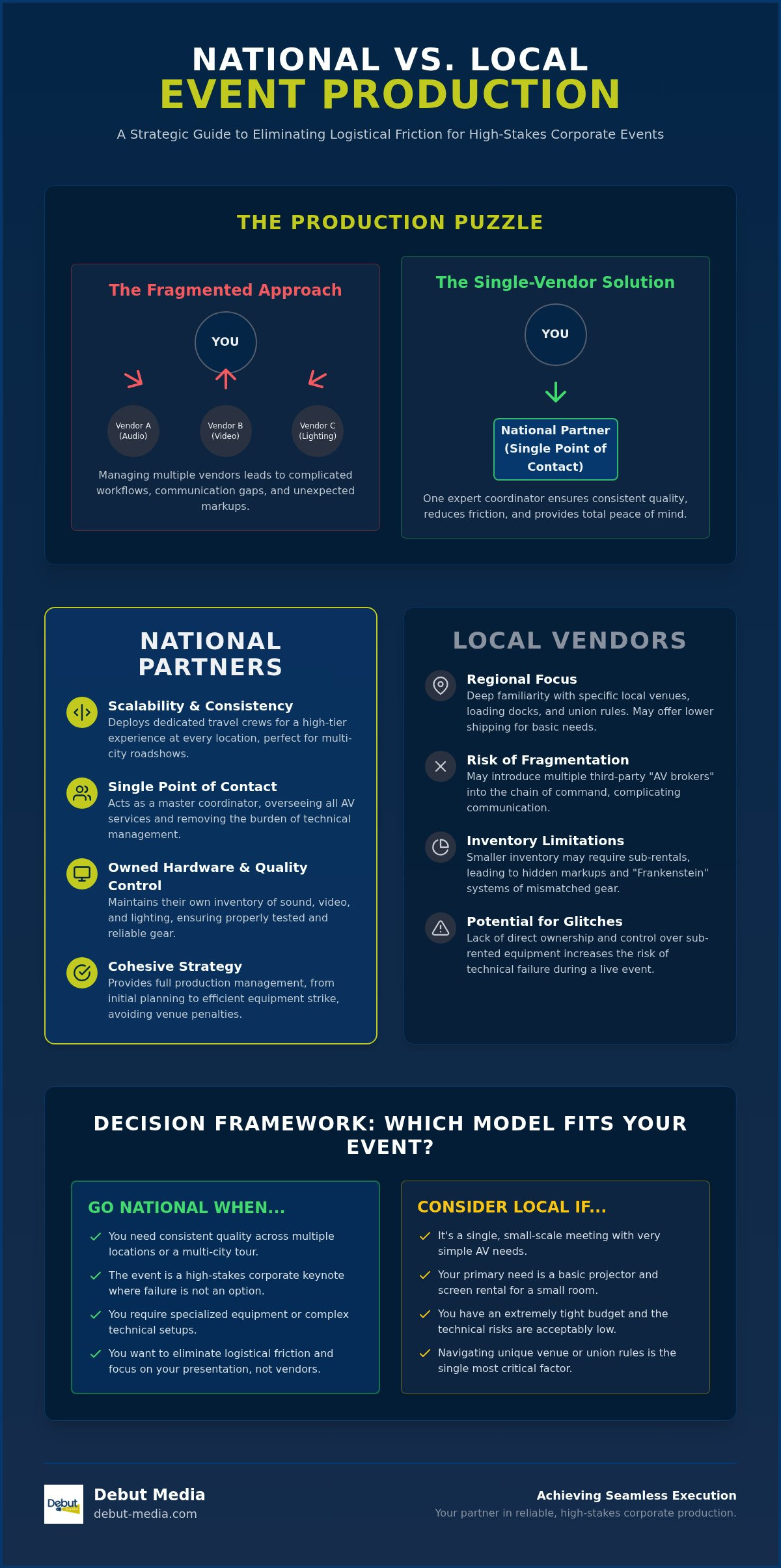
National firms specialize in scalability and consistency. These companies deploy dedicated travel crews who understand your brand's specific technical requirements, whether you're hosting a corporate keynote in a major metro market or a large-scale trade show at a convention destination. By maintaining a single point of contact, national partners act as master coordinators who oversee every detail of your audio visual services. This model is built on standardized processes that prevent the technical glitches often caused by unfamiliarity with a client's specific workflow. It's about providing the same high-tier experience at every stop on a multi-city roadshow, ensuring your message never loses its impact due to local equipment variations.
The Local Production Landscape
Local vendors often offer deep familiarity with specific regional venues. They can navigate loading docks and union rules with ease, which can sometimes reduce shipping costs for basic needs like a projector and screen rental. However, local companies may face limitations when it comes to inventory depth or specialized hardware. If your event scales suddenly, a smaller regional shop might rely on sub-rentals from third parties. This introduces "AV brokers" into your chain of command, which can lead to fragmented communication and hidden markups. While local expertise is often sufficient for small-scale meetings, it can struggle to meet the demands of high-stakes corporate environments where specialized trade show and expo support is required.
The shift toward full production management means your choice of partner defines the reliability of your event. A national partner doesn't just provide gear; they provide a cohesive strategy that removes the burden of technical oversight from your shoulders. This transition ensures that instead of managing multiple vendors, you're working with a single, organized entity that has seen every possible scenario and has a plan ready for each one.
Uncovering the Hidden Logistics of Corporate Production
Logistics often dictate the success of a high-stakes corporate presentation. When choosing between national vs local event production companies, the decision usually comes down to who controls the physical hardware. Many Meeting, Convention, and Event Planners spend significant time soliciting bids, but they often overlook the technical reliability of the equipment being quoted. If a provider doesn't own their inventory, they're essentially acting as a broker. This introduces a layer of risk that can lead to technical glitches and unexpected budget creep.
The Hardware Factor: Ownership vs. Brokering
A production company that owns its sound, video, and lighting gear provides a level of quality control that middlemen simply can't match. When a provider uses their own hardware, they know the history of every cable and the lifespan of every bulb. Brokers, on the other hand, source equipment from various local sub-rental houses. This can result in a "Frankenstein" system where mismatched components increase the likelihood of failure during a live presentation. To verify your provider's status, ask for a detailed inventory list or a tour of their warehouse. Securing a professional projector rental directly from the source ensures that the technology has been properly maintained and tested before it arrives at your venue. This direct ownership model eliminates the hidden markups often found in local sub-rental agreements.
Technical Setup and Strike Logistics
The efficiency of your technical crew during the load-in and load-out phases can make or break your event budget. Equipment strike is the systematic dismantling and removal of AV gear to avoid venue penalties. In many corporate venues, missing a "hard out" time by even thirty minutes can trigger massive overtime fees. Understanding the logistical reach of national vs local event production companies helps you identify which partner can move faster. National partners typically use specialized crews who travel with the equipment, ensuring they are intimately familiar with the setup. These operators don't just manage the hardware; they act as a stabilizing force during high-pressure keynotes. They understand the signal flow and have redundancy plans ready before a glitch even occurs. This level of oversight provides the peace of mind that every detail is handled. If you are looking for a partner to manage these complexities, our team provides comprehensive audio visual services that prioritize reliability and speed.
The Single-Vendor Advantage: Solving the Fragmented Production Puzzle
Fragmented communication is the primary source of event stress. When you hire separate vendors for audio, lighting, and event management, you're creating a web of disparate contacts that often leads to "finger-pointing" when a technical issue arises on site. This complexity doesn't just increase your workload; it introduces significant risk to your production value. Bundling your technical needs under one roof provides a clear financial benefit and ensures a cohesive strategy. It's about moving away from a transactional feel toward a partnership-based approach where your provider acts as a stabilizing force for the entire project.
Eliminating Logistical Friction
Consider the workflow of a typical corporate seminar. In a fragmented model, you're coordinating with a local AV shop for sound, a separate lighting company for the stage, and perhaps an independent project manager. This creates immense logistical friction during the planning phase. When you work with a single point of contact, that person acts as a seasoned "fixer." They handle all the moving parts, from the initial site survey to the final equipment strike, so you don't have to. This consolidated oversight is a major differentiator in the national vs local event production companies debate. A national partner replaces the chaos of dozens of email threads with one streamlined channel of communication, ensuring that every detail is captured and executed correctly.
Trade Show and Expo Synergy
High-impact brand presence requires total consistency. If your general session looks world-class but your exhibitor booth feels disconnected or technically inferior, your corporate message is diluted. Using your main production partner for trade show logistical support ensures that your lighting, graphics, and technical standards remain uniform across the entire venue. This synergy is particularly valuable for large exhibitors who need to streamline exhibit hall services. Instead of managing a separate booth contractor, you leverage the same specialized crew that already knows your brand's technical requirements. This methodical approach ensures that every detail, from the keynote stage to the trade show floor, is handled with the same level of expert oversight and reliability.
Decision Framework: When to Go National vs. Local
Choosing between national vs local event production companies isn't a matter of finding the closest warehouse. It's a strategic calculation based on risk and resource management. To make the right choice, you must look beyond the initial quote and calculate the Total Cost of Management. This includes the hours your team spends on vendor communication and the potential financial impact of a technical failure. A methodical decision framework helps you identify which model provides the stability your project requires.
Complexity and Scale Assessment
High-stakes events require a higher level of redundancy and specialized expertise. For instance, a fundraiser with a complex run-of-show needs dedicated charity gala audio visual support to ensure every transition is flawless. Event scalability is the ability to replicate a high-quality technical experience across multiple geographic locations. If you're planning a multi-city roadshow, a national partner ensures your keynote looks and sounds identical in every venue. While a local shop might handle a standard meeting well, they often lack the inventory depth to scale quickly if your attendee count or technical requirements suddenly grow.
Venue infrastructure also plays a critical role in your decision. Many hotels and convention centers push "in-house" AV services, but these often come with high commissions that don't translate to better technical support. You should evaluate whether the venue's existing gear meets your standards or if you need an external partner to bring in specialized hardware. Audit the production company’s inventory to ensure they own the sound, video, and lighting equipment they're quoting. If they rely on sub-rentals, you're essentially paying a middleman markup for gear they don't control.
The RFP Audit: Spotting Red Flags
The Request for Proposal (RFP) process is where you can spot potential logistical friction before it happens. Look for "ghost" equipment, which is hardware listed in a quote that the provider doesn't actually own. This is a significant red flag for quality control. You should also compare technical operation fees carefully. Are you paying for a dedicated, specialized crew that understands your signal flow, or just a generic "tech-on-call" provided by the venue? A professional quote should also include a documented strike plan. This ensures the systematic dismantling of gear happens quickly enough to avoid venue overtime penalties. If you're looking for a partner that prioritizes this level of detail, our team provides integrated event management and AV services that act as a steady hand for your entire production.
Achieving Seamless Execution with Debut Media
Choosing between national vs local event production companies becomes simple when you prioritize reliability over proximity. At Debut Media, we act as the stabilizing force your high-stakes corporate event requires. We move beyond the transactional nature of equipment rental to provide a partnership-based approach that eliminates logistical friction. By serving as a singular, organized entity, we replace the need for fragmented communication across multiple vendors. Our team handles every technical detail, ensuring your message is delivered with precision and impact.
Our philosophy focuses on comprehensive event production that integrates audio visual services, lighting, and management into one cohesive workflow. This "One-Stop" model is designed to provide emotional relief for planners who are often overwhelmed by technical complexities. We take the burden of coordination off your shoulders, allowing you to focus on your attendees while we manage the behind-the-scenes mechanics.
Our In-House Production Advantage
The peace of mind we provide is built on a foundation of direct ownership. We use our own in-house sound, video, and lighting hardware for every project. This ensures that every piece of technology is maintained to our exacting standards, avoiding the "Frankenstein" systems often found with brokers who rely on local sub-rentals. Our specialized crew travels with the equipment, so the same experts who planned your event are the ones handling the technical setup and the final equipment strike. This consistency eliminates the "finger-pointing" that occurs when disparate teams are forced to work together. We are your steady hand, ensuring that every keynote presentation and gala transition is flawless.
National Reach, Personal Coordination
Debut Media acts as a master coordinator for corporate events across the United States. We provide a single point of contact for all travel, logistics, and technical execution, regardless of your venue's location. This centralized planning model ensures that your brand standards are replicated perfectly from city to city. You won't have to re-explain your technical requirements to a new local shop at every stop on your roadshow. We already know your signal flow, your preferred lighting cues, and your specific presentation needs. This level of expert oversight provides the reassurance that every moving part is being managed by a seasoned professional.
Don't let fragmented communication or technical uncertainty compromise your next event. Our methodical approach to production ensures that your vision is executed without the stress of logistical hurdles. Contact Debut Media today to learn how we can simplify your next production and provide the reliable technical support your organization deserves.
Securing Technical Reliability for Your Future Events
Choosing the right partner is about more than proximity. It's about finding a master coordinator who replaces fragmented vendor communication with a single point of contact. Whether you're planning a complex gala or a multi-city roadshow, the decision between national vs local event production companies should prioritize long-term reliability and the elimination of logistical friction. By focusing on providers who own their in-house equipment, you protect your budget from hidden markups and your presentation from technical glitches.
You don't have to manage these moving parts alone. Working with a partner who provides specialized crews for setup, operation, and strike ensures that every phase of your event is handled with expert oversight. This methodical approach transforms your production from a source of stress into a seamless, professional experience. Streamline your next event with Debut Media’s integrated production services. We're here to act as your steady hand, ensuring your vision is executed perfectly every time.
Frequently Asked Questions
What is the main difference between national and local event production companies?
The primary difference lies in technical scalability and consistency. National companies provide standardized workflows and dedicated crews that travel with your project to ensure the same quality in every city. Local companies offer regional venue knowledge and lower shipping for basic setups. Choosing between national vs local event production companies depends on whether you prioritize venue proximity or a repeatable technical standard.
Does hiring a national production company always cost more in travel fees?
National partners do charge for travel, but these costs are often offset by other efficiencies. Since they use in-house equipment, they eliminate the middleman markups associated with local sub-rentals. You also save on the time your team would spend onboarding new local vendors for every stop on a roadshow, which makes the total cost of management more predictable.
Why is a single point of contact important for corporate event planning?
A single point of contact acts as a master coordinator who oversees every technical detail from planning to execution. This prevents the fragmented communication that leads to "finger-pointing" during high-stakes moments. By having one person responsible for everything from audio visual services to the final equipment strike, you gain the peace of mind that nothing will slip through the cracks.
What should I look for in an event production RFP?
You should look for transparency regarding equipment ownership and crew specialization. A high-quality RFP clearly outlines the strike plan and lists specific hardware rather than vague categories. Be wary of quotes that don't specify if the technicians are dedicated operators or just general labor provided by the venue, as this can lead to unexpected technical gaps.
Can a local production company handle a large-scale corporate gala?
While some local shops are capable, many lack the inventory depth and redundancy required for high-stakes environments. Large galas often need specialized lighting and advanced video switching that smaller regional providers must sub-rent. National partners bring a level of specialized experience that ensures a flawless execution for large audiences without relying on third-party hardware.
What are the risks of using a venue’s in-house AV provider?
In-house providers often pay high commissions to the venue, which can lead to inflated prices without an increase in technical quality. Their staff may be managing multiple events simultaneously, meaning they aren't dedicated solely to your keynote. An independent partner provides a steady hand and a crew focused entirely on your specific technical requirements and brand standards.
How does equipment ownership affect the quality of my event production?
Ownership allows for total quality control over every component in the signal chain. When a production company uses their own sound and video gear, they know the equipment's maintenance history and reliability. Providers who sub-rent often end up with mismatched hardware from various sources, which increases the risk of technical glitches during live presentations.
What is included in event equipment strike services?
Equipment strike involves the systematic dismantling and removal of all technical hardware after the event ends. This is a critical logistical phase where speed is essential to avoid venue overtime fees. A specialized crew handles the strike to ensure the gear is packed safely and the room is returned to the venue on schedule, removing the burden from your team.


