
Reducing Event Logistical Friction: A 2026 Guide to Seamless Corporate Production
Most corporate events don't fail because of a lack of vision; they fail under the weight of too many moving parts. When you're juggling five different vendors for sound, lighting, and staging, communication silos aren't just a risk, they're a certainty. A strategic focus on reducing event logistical friction is the only way to transform a chaotic production into a seamless brand experience. It's the difference between a keynote interrupted by technical glitches and a presentation that flows with professional precision.
You likely recognize the stress of watching your budget bloat as overlapping service fees pile up from various providers. It's frustrating to feel like a master air traffic controller instead of a strategic leader during your own production. This guide provides a clear roadmap to eliminate those hidden bottlenecks and reclaim your peace of mind. We'll walk through the process of unifying your technical needs under a single point of contact, ensuring predictable costs and a calm, authoritative atmosphere on the day of your event.
Table of Contents
What is Event Logistical Friction? Defining the Modern Planning Bottleneck
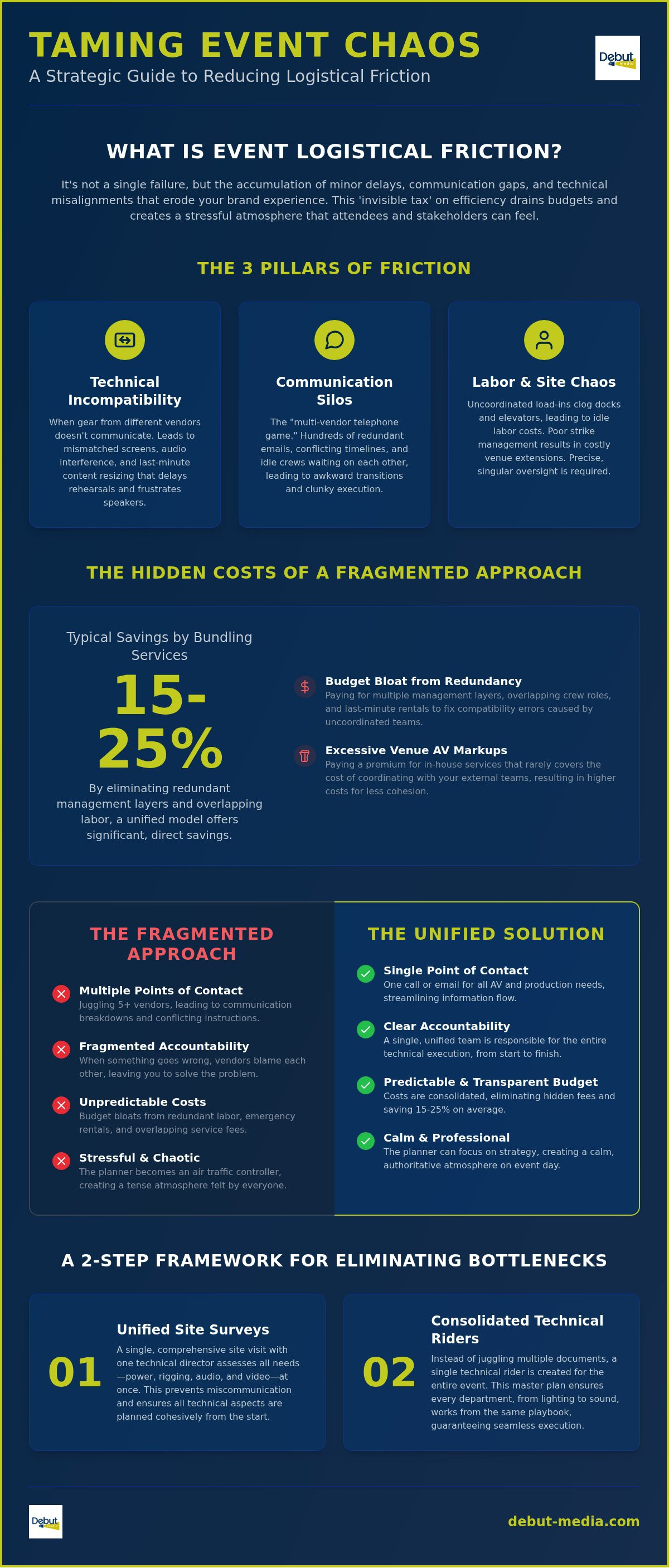
In corporate production environments, friction isn't usually a single catastrophic failure. Instead, it's the sum of small, uncoordinated parts. Logistical friction is the accumulation of minor delays, communication gaps, and technical misalignments that slowly erode the quality of your brand experience. Logistical friction is the 'invisible tax' on event efficiency. It drains your budget through labor redundancy and emergency fixes, often becoming the primary cause of budget overruns in high-stakes productions.
The three pillars of friction include technical incompatibility, vendor silos, and physical site constraints. These pillars represent the structural gaps where money and time disappear. Understanding Event management through this lens allows you to see why reducing event logistical friction is a strategic necessity rather than just a tactical preference. When these elements aren't aligned, the resulting chaos creates an atmosphere of stress that attendees and stakeholders can feel immediately.
The Technical Friction: When Gear Doesn't Talk
Hardware issues often stem from a lack of cohesion between different technical teams. For instance, mismatched aspect ratios between screens and projectors can force last-minute content resizing, delaying your rehearsal and frustrating speakers. Uncoordinated wireless frequency management is another common hurdle. It often leads to audio interference, causing microphones to cut out during a CEO's keynote. Specialized technical support acts as a stabilizing force here. By handling sound, video, and lighting under one roof, an integrated team ensures all hardware is pre-vetted for compatibility, preventing the "tech debt" that accumulates when separate vendors bring gear that won't play nice together.
The Communication Friction: The Multi-Vendor Telephone Game
Communication silos are the second major bottleneck that planners face. Managing five or more vendors often leads to hundreds of redundant emails and conflicting load-in timelines. If the lighting team doesn't know when the staging crew is finishing, you end up paying for idle labor while crews wait for space to open up. This fragmented planning directly impacts the final delivery. When the technical lead doesn't have a direct line to the content creator, transitions between speakers become clunky and awkward. Transitioning to a single point of contact is the primary antidote to this planning anxiety and a proven method for reducing event logistical friction. It replaces a web of confusing emails with a clear, streamlined flow of information, ensuring every detail is handled by someone who understands the full scope of the production.
The Hidden Costs of Fragmented Event Production
Fragmented production models create financial leaks that often go unnoticed until the post-event audit. When you hire separate entities for audio, video, and lighting, you aren't just paying for equipment; you're paying for multiple management layers. This redundancy is a primary driver of budget bloat. Industry data suggests that bundling all production services with a single company can typically save 15-25% compared to hiring separate vendors. Focusing on reducing event logistical friction through a single point of contact isn't just about ease; it's about financial stewardship. These savings come from eliminating overlapping labor and the "tech debt" that occurs when uncoordinated teams must rush in last-minute rentals to fix compatibility errors.
Another significant factor is the venue AV markup. Many venues apply a substantial percentage to their in-house services, yet this premium rarely covers the cost of reducing event logistical friction between your external speakers and the house gear. You're often paying more for less coordination. By bringing in a unified team that manages everything from the loading dock to the final strike, you bypass these hidden inefficiencies and ensure your budget is spent on impact rather than oversight.
Redundant Labor and Site Management Fees
Managing a loading dock and freight elevator schedule is a complex task. When five vendors arrive at once, chaos ensues, and labor costs skyrocket as crews sit idle. A unified team streamlines this process by coordinating a single load-in window. This efficiency extends to the equipment strike as well. Reducing the strike window through better coordination can save you from costly venue rental extensions. Following event logistics best practices ensures that site management fees are minimized through precise, singular oversight of the physical environment.
Opportunity Costs of Planning Friction
The most expensive cost is often the time of your internal team. Your marketing or communications staff shouldn't spend their day acting as AV mediators between conflicting vendors. This friction prevents them from focusing on attendee engagement and high-level strategy. For a deeper look at streamlining your internal workflow, see our guide on Corporate Event Logistics Management. Choosing a partner that handles the heavy lifting allows your team to remain present and focused on the event's success. If you're ready to simplify your next production, consulting with an integrated AV specialist can provide the stabilizing force your event needs.
Single Vendor vs. Multi-Vendor Production Models
High-stakes events like gala dinners and executive seminars leave no room for error. When a screen goes black mid-presentation, the source of the problem must be identified in seconds. In a multi-vendor model, you often witness a "blame game" where the video team blames lighting interference, and the sound crew claims the signal wasn't theirs to manage. A unified production architecture eliminates this confusion. One team owns the room, ensuring that every piece of hardware is synchronized before the first attendee arrives. This level of On-Site Event Technical Operation is the gold standard for organizations that prioritize a flawless brand image.
Accountability and the 'One Throat to Choke' Philosophy
The psychological relief of having a single partner cannot be overstated. We call this the "Fixer" persona. Instead of managing five separate contracts, you have one point of contact who manages the entire signal chain. This oversight covers everything from the physical microphone on the lectern to the digital recorder in the back of the room. When one entity is responsible for the whole system, they're incentivized to solve problems pre-emptively. This proactive approach is a cornerstone of reducing event logistical friction, providing a stabilizing force that keeps the atmosphere professional and calm even during complex transitions.
Budget Predictability and Bundled Value
Individual vendor invoices are often riddled with hidden fees for transportation, separate project management, and uncoordinated labor. Bundled quotes offer a level of transparency that piece-meal rentals simply can't match. Elite production firms use a "Zero Surprise" model, where the initial quote covers the full technical scope. This approach is instrumental in reducing event logistical friction because it aligns the budget with the actual technical requirements from day one. You don't have to worry about last-minute add-ons to make disparate systems work together.
Choosing bundled AV services for corporate events typically provides better value because it removes the markup of multiple middlemen. You aren't just saving money; you're buying reliability. To see how these components fit together, explore our guide on Professional Audio Visual Services. By consolidating your technical needs, you ensure that your event production is a cohesive brand statement rather than a collection of uncoordinated parts. It's the most direct path to a predictable, stress-free execution.
A Strategic Framework for Eliminating Planning Bottlenecks
Eliminating bottlenecks requires a methodology, not just a checklist. A disciplined approach to reducing event logistical friction starts long before the first case arrives at the venue. By following a structured five-step framework, you transform a collection of technical tasks into a synchronized operation. This process begins with a unified site survey and moves through the consolidation of technical requirements, centralized communication, and a rigorous rehearsal schedule. It concludes with a coordinated equipment strike, an often overlooked phase that can make or break your venue relationship and budget.
Step 1: Conduct a unified site survey with all technical leads present to identify physical constraints early.
Step 2: Consolidate the technical rider to ensure hardware compatibility across all departments.
Step 3: Establish a centralized communication hub where every stakeholder has access to real-time updates.
Step 4: Implement a rigorous pre-event rehearsal schedule to iron out transitions and timing.
Step 5: Execute a coordinated equipment strike to clear the venue efficiently and avoid overtime fees.
The Power of the Unified Technical Rider
A unified technical rider is the blueprint for a friction-free event. By consolidating power requirements, rigging points, and data bandwidth into a single document, you prevent the common "adapter hunting" that plagues fragmented productions. This proactive documentation is essential for reducing event logistical friction because it forces technical alignment during the planning phase. It ensures that graphic design services for trade shows perfectly match the physical display specs of your screens. When every department works from the same set of technical truths, you eliminate the misalignments that lead to last-minute hardware swaps and unbudgeted rental fees.
Site Surveys and Infrastructure Planning
Physical site constraints are a major source of friction if they aren't addressed early. A professional Projector and Screen Rental requires a pre-visit to check throw distances and ambient light levels. Without this step, you risk having visuals that are washed out or improperly sized for the room. Planning must also include mapping out the Event Equipment Strike before the doors even open. A well-coordinated strike ensures that gear is packed and moved in a logical sequence, preventing loading dock jams. For detailed site setup tips, explore our guide on Professional Projector Rental. If you want to see how an integrated team can streamline your next production, contact Debut Media today for an expert consultation.
Achieving Seamless Execution with Unified AV and Production
True seamlessness is achieved when the technical elements of an event become invisible. When sound, video, and lighting are integrated into a single, cohesive narrative, the audience focuses on your message rather than the mechanics of the delivery. This level of synchronization is only possible by reducing event logistical friction at every stage of the production lifecycle. By consolidating these services under one umbrella, you transform your event from a series of potential technical challenges into a strategic success that reflects the quality of your brand.
Debut Media functions as a stabilizing force for corporate event planners who are tired of the fragmentation that usually defines large-scale productions. Our in-house technical support team provides a reassuring environment where every detail is handled with expert oversight. We don't just provide equipment; we provide the peace of mind that comes from knowing a master coordinator is managing every moving part. This partnership-based approach ensures that the energy of your planning team remains focused on attendee experience rather than troubleshooting hardware misalignments.
The Stabilizing Force: Why Partnership Trumps Transaction
Moving from a transactional model of "renting gear" to "investing in a production partner" changes the entire dynamic of an event. A transaction ends when the invoice is paid; a partnership is built on the shared goal of a flawless execution. The emotional relief of knowing the technical details are under expert oversight allows you to step into your role with confidence. As your master coordinator, we handle the complex signal chains and logistical hurdles, allowing you to remain present and authoritative during the event. This shift in perspective is the ultimate tool for reducing event logistical friction, turning a stressful day into a professional triumph.
Next Steps: Simplified Vendor Management
Transitioning from multiple vendors to a single production partner is a straightforward process that begins with a shift in planning strategy. When you're ready to consolidate your technical needs, prepare for your first discovery call by identifying your primary communication pain points and budget priorities. A unified AV provider will look for ways to streamline your technical rider and site survey process to eliminate the bottlenecks we've discussed. If you're ready to move away from the chaos of fragmented planning, you can simplify your next event with Debut Media's unified production services. Our team is ready to act as the steady hand that ensures your vision is delivered without compromise.
Elevating Your Production Standards for 2026
Transitioning from a fragmented planning process to a unified production architecture is the most effective way to protect your brand and your budget. By identifying hidden bottlenecks and implementing a strategic framework for site surveys and technical riders, you eliminate the "invisible tax" that drains resources. Reducing event logistical friction isn't just a tactical improvement; it's a commitment to a professional, stress-free environment for your speakers and attendees alike.
When you partner with a team that owns the entire technical signal chain, you gain more than just gear. You gain a stabilizing force that replaces communication silos with a single point of contact for all AV and logistics. Efficiency creates relief. This integrated approach ensures that transitions are smooth and the atmosphere remains calm. Our in-house expert technical crew provides transparent, bundled pricing with zero surprises, ensuring your only focus is the success of your message.
Streamline your next corporate event with Debut Media's expert production services. You have the vision; we have the steady hand to bring it to life with precision and reliability.
Frequently Asked Questions
What exactly is event logistical friction?
Event logistical friction is the collection of communication gaps, technical misalignments, and minor delays that disrupt a production. Think of it as an invisible tax on your efficiency. It often results from vendor silos where different teams don't coordinate their timelines or hardware. By identifying these bottlenecks early, you can focus on reducing event logistical friction to ensure your brand experience remains professional and cohesive from start to finish.
How does a single point of contact reduce event costs?
A single point of contact reduces costs by eliminating redundant management fees and overlapping labor hours. When one firm manages the entire production, you aren't paying for multiple project managers to attend the same meetings. Bundling all production services can typically save between 15% and 25% compared to hiring separate vendors. This streamlined approach also prevents the "tech debt" of last-minute rentals needed to fix uncoordinated equipment mistakes.
Why is vendor fragmentation a problem for corporate seminars?
Fragmentation creates communication silos that lead to technical glitches and schedule delays. In a corporate seminar, the audio team might not know the video team's specific signal requirements, leading to awkward transitions during a keynote. This disconnect often results in a "blame game" when issues arise. A unified team ensures that every department is synchronized, which is essential for maintaining a calm and authoritative atmosphere throughout the event.
Can a single production company handle AV, lighting, and management?
Yes, a comprehensive production partner like Debut Media manages sound, video, lighting, and full event logistics. We provide an in-house team that handles everything from initial site surveys to the final equipment strike. This integrated model ensures that all technical elements work together seamlessly. It replaces a web of confusing vendor emails with a single, organized entity that takes full accountability for the success of your corporate production.
What should I look for in a corporate AV production partner?
Look for a partner that offers an in-house technical crew and a single point of contact. Reliability is paramount, so prioritize firms with experience in high-stakes environments like galas and national conferences. You want a "fixer" who understands the full scope of reducing event logistical friction. Ensure they provide transparent, bundled pricing and have a proven track record of managing complex signal chains without relying on external subcontractors.
How do unified technical riders prevent glitches during a keynote?
Unified technical riders consolidate all power, rigging, and data bandwidth requirements into one master document. This prevents the "adapter hunting" that often happens when separate vendors bring incompatible gear. By aligning every technical department during the planning phase, you ensure that hardware is pre-vetted for compatibility. This proactive coordination is the best way to prevent audio interference or mismatched aspect ratios from disrupting a high-profile keynote presentation.
What is an equipment strike and why does it matter for logistics?
An equipment strike is the systematic teardown and removal of gear after an event concludes. It matters because uncoordinated strikes often lead to loading dock jams and expensive venue overtime fees. A professional production team plans the strike before the event even begins. This ensures that equipment is packed in a logical sequence, allowing for a quick and efficient exit that respects the venue's schedule and your budget.
Is a unified production model more expensive than hiring separate vendors?
A unified production model is actually more cost-effective because it removes the markups associated with multiple middlemen. While a single quote might look larger upfront, it covers the entire technical scope with zero surprises. Hiring separate vendors often leads to hidden costs for transportation, separate project management, and emergency fixes. Bundled services provide better value by streamlining labor and ensuring that every dollar spent contributes directly to a seamless execution.


