
Reducing Event Logistical Friction: The 2026 Guide to Seamless Production
Most corporate event failures aren't caused by a lack of vision; they're caused by the invisible gaps between disconnected vendors. When your AV team, lighting technicians, and event managers operate in silos, the resulting friction doesn't just create stress; it creates risk. You've likely experienced the frustration of managing too many points of contact while worrying if the technical setup will actually hold together under the pressure of a live audience. It's a common pain point that turns what should be a milestone moment into a logistical nightmare.
Reducing event logistical friction is the only way to reclaim control over your production and ensure a flawless execution. You deserve a streamlined process where accountability is clear and technical glitches are eliminated before they ever reach the stage. In this 2026 guide, we'll show you how to identify hidden bottlenecks and bridge communication gaps. We'll walk through a methodical approach to integrated planning that replaces chaos with professional oversight, providing the stability and peace of mind necessary for a truly successful corporate event.
Table of Contents
What is Event Logistical Friction and Why Does It Matter?
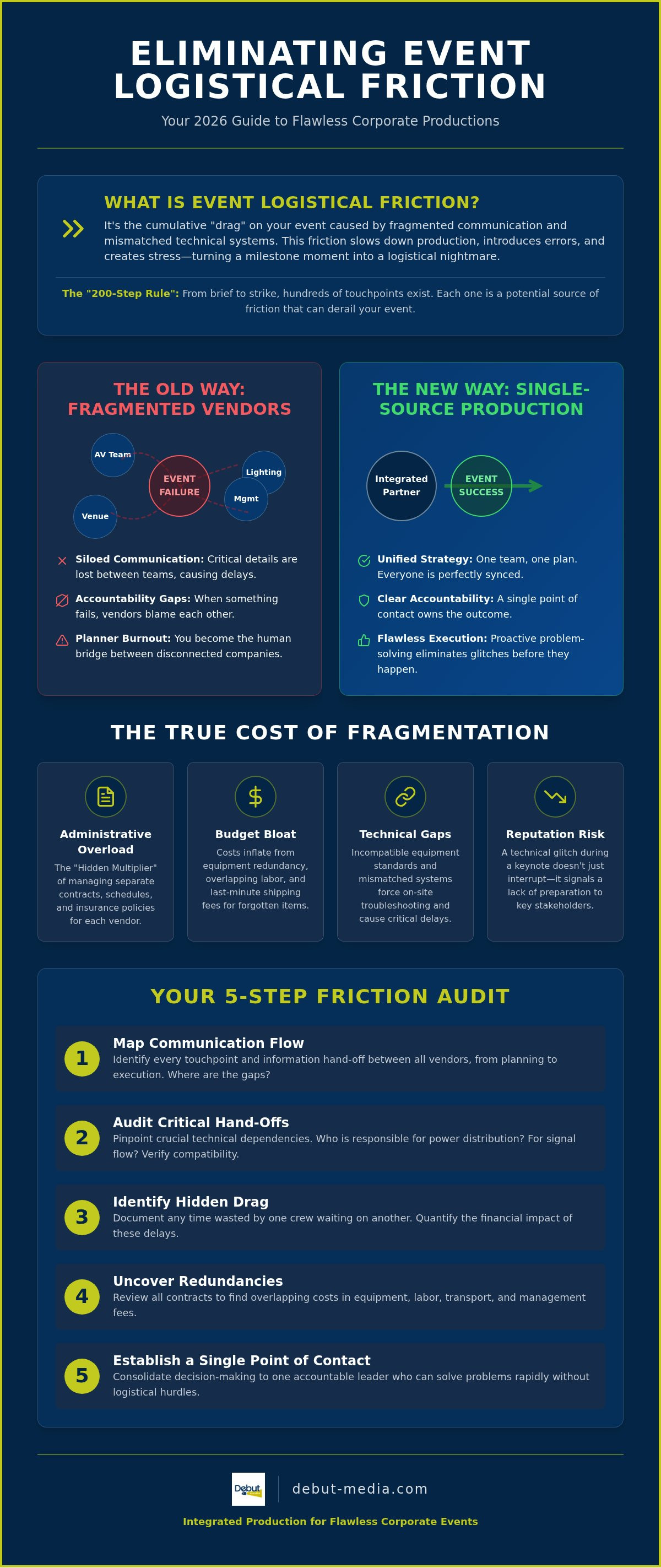
In high-stakes corporate production, logistical friction is the cumulative "drag" created by fragmented communication and mismatched technical systems. It acts as a resistance force that slows down production and increases the likelihood of error. When you're managing a corporate seminar or a national gala, this friction manifests in visible ways: sudden technical delays during rehearsals, unexpected budget overruns due to last-minute equipment needs, and high levels of stakeholder stress. It's the difference between a production that feels effortless and one that feels like a constant struggle against moving parts.
Professional Event management often deals with the "200-Step Rule." This principle suggests that from the initial creative brief to the final equipment strike, there are hundreds of individual touchpoints where information must be shared or an action taken. Each step is a potential source of friction. As we move through 2026, corporate standards require higher velocity and lower friction than ever before. Attendees expect integrated technology ecosystems and immersive experiences, leaving zero margin for the delays caused by disorganized logistics. Focusing on reducing event logistical friction isn't just about convenience; it's a structural requirement for modern event success.
The Anatomy of Logistical Drag in Corporate Events
Logistical drag usually starts with information silos. When your AV team and venue coordinators aren't synced, critical details like power load requirements or loading dock schedules get lost. This lack of cohesion leads to the "Hand-off Gap." This is the specific window during setup where most technical errors occur because one vendor assumes another has handled a task. Additionally, disparate equipment standards often force on-site troubleshooting. If lighting rigs from one provider aren't natively compatible with the control desk from another, your team wastes valuable hours fixing problems that shouldn't exist.
The Emotional and Financial Impact of Friction
The financial cost of friction is often found in administrative overhead. Managing five separate vendors instead of one creates a "hidden multiplier" of emails, contracts, and meetings. This leads to intense planner burnout, as the coordinator becomes a human bridge between disconnected companies. Beyond the internal team, there are significant brand reputation risks. A technical glitch during a keynote doesn't just interrupt the flow; it signals a lack of preparation to your most important stakeholders. Logistical friction is the invisible barrier between a plan and its perfect execution.
The True Cost of Fragmented Event Vendor Management
When you hire separate vendors for sound, lighting, and management, you aren't just paying for services; you're paying a fragmentation tax. This "Hidden Multiplier" increases your administrative overhead significantly because each additional contract requires its own set of meetings, emails, and oversight. Beyond the paperwork, equipment redundancy often inflates your budget. You might find yourself paying for two separate transport crews and two different sets of rigging gear when a single, coordinated team could have handled everything with half the resources. Reducing event logistical friction starts with recognizing that these overlapping costs are preventable waste.
The most expensive part of a fragmented event is often "Ineffective Labor." This occurs when on-site crews from different companies spend hours mediating responsibilities or waiting for another team to finish their setup. While a "lowest bid" per item might look attractive on your initial spreadsheet, it frequently leads to the highest total logistical cost. The lack of coordination creates gaps that must be filled with expensive, last-minute labor or overnight shipping fees for forgotten components.
Administrative Friction: The Contract Trap
Managing insurance certificates, load-in schedules, and strike times for five different entities is a recipe for planner burnout. It becomes nearly impossible to achieve true accountability when "everyone is responsible, so no one is." If the video feed fails, the AV team might blame the lighting crew's power draw, while the venue coordinator points to a cabling issue. Following Event Logistics: Best Practices suggests that streamlining procurement through a unified event production strategy is the most effective way to close these accountability gaps.
Technical Friction: Mismatched Standards
Technical glitches are rarely the fault of a single piece of equipment; they usually happen in the "Rental Gap" between vendors. This is where signal chain failures occur because sound, video, and lighting systems weren't pre-integrated in a warehouse before arriving on-site. You might lose hours of rehearsal time searching for specific adapters or cables that one vendor assumed the other would provide. Specialized audio visual services benefit immensely from a holistic equipment inventory where every component is tested to work together. Partnering with a stabilizing force that owns the entire technical stack ensures these hidden friction points never reach your stage.
Single-Source Production: The Strategic Fix for Logistical Drag
The most effective strategy for reducing event logistical friction is the transition from a fragmented vendor list to a single-source production model. This approach brings audio visual services, lighting design, and event management under one roof. Instead of acting as a mediator between competing interests, you partner with a unified team that shares a single set of goals. This structural change eliminates the "blame game" that often occurs during live operations; if a technical issue arises, there's no finger-pointing between vendors. One company owns the entire technical stack and the responsibility for its success.
A single-source model introduces the "Single Point of Contact" (SPOC) advantage. This master coordinator acts as your primary liaison, translating your vision into technical instructions for the entire crew. It speeds up decision-making because there's no need to wait for three different company owners to approve a change. Integrated teams also perform pre-event "dry runs" in their own warehouse. They set up your specific rig, test the signal chains, and pre-configure equipment racks before anything ever reaches the venue. Fragmented teams simply can't offer this level of pre-production certainty.
The Efficiency of Unified Logistics
Logistics become significantly leaner when managed by a single entity. You move from five trucks arriving at different times to a single, consolidated load-in. This reduces dock congestion and lowers transportation costs. Shared labor pools further streamline the process; you work with technicians who understand the entire ecosystem, not just their specific piece of gear. Because the team works together daily, they move with a level of synchronicity that fragmented crews cannot match, often cutting on-site setup time by hours.
Strategic Alignment and Brand Consistency
Maintaining a cohesive brand image across multiple event sessions requires tight coordination. A single partner ensures the gala lighting matches the trade show floor graphics perfectly because they've planned both simultaneously. This level of corporate event logistics management ensures your vision remains consistent from the first keynote to the final breakout session. You gain the peace of mind that comes from having a stabilizing force in the production booth, allowing you to focus on your attendees while the experts handle the technical complexity.
Audit Your Event: 5 Steps to Identify Friction Points
Transformation begins with a clear view of your current operations. Reducing event logistical friction isn't a one-time fix; it's a systematic process of identifying where your plan meets resistance. By auditing your workflow before the first piece of gear leaves the warehouse, you can neutralize bottlenecks that would otherwise disrupt your live production. This audit moves beyond simple checklists to analyze the actual mechanics of how your team, vendors, and venue interact.
Step 1: Map the communication flow. Chart every interaction between your internal team and external stakeholders. If three people are emailing the venue about the same power drop, you've found a friction point.
Step 2: Evaluate "Technical Hand-off" points. Review your run-of-show specifically for transitions. These moments, where one technician hands control to another, are the most likely spots for signal failures.
Step 3: Analyze the "Vendor-to-Attendee" ratio. High-complexity events often suffer from having too many specialized vendors relative to the audience size. Simplification here often yields the highest ROI.
Step 4: Identify manual processes. Look for tasks like registration or check-in that still rely on manual data entry. Centralizing these through a single production portal reduces human error.
Step 5: Stress-test your "Strike" plan. Visualize the exit. If your plan doesn't account for dock congestion or specialized gear packing, your load-out will likely go over time and budget.
Mapping Stakeholder Communication
Effective production depends on knowing exactly who speaks to whom. You need to define who speaks to the venue and who manages the keynote speaker's technical needs. When these roles aren't clear, redundant emails clog inboxes and important updates get lost in the noise. A comprehensive communication map reveals hidden information silos where critical technical data often goes to die. Transitioning to a centralized production portal ensures every stakeholder sees the same "source of truth" in real time.
Evaluating the Strike and Load-Out
The end of an event is frequently the point of highest friction. Crews are tired, the pressure of the live show is over, and the rush to exit can lead to damaged equipment or venue penalties. Ensuring your trade show logistical support includes a seamless exit strategy is vital for maintaining your budget. Specialized technical strike services ensure that high-value audio visual gear is handled with care during the final hours. If you want to see how an expert audit can transform your next production, you can partner with a stabilizing force to review your logistics today.
How Debut Media Eliminates Friction for Corporate Leaders
Debut Media is built on the principle that complexity shouldn't lead to chaos. We serve as a single point of contact for national corporate events, providing the stabilizing force needed to navigate the technical and logistical hurdles of modern production. By keeping audio visual services, lighting, and management in-house, we eliminate the need for third-party rentals. This structural integration is the most direct method for reducing event logistical friction, ensuring that every piece of equipment and every technician is part of a unified, pre-tested system. Our approach transforms a fragmented process into a streamlined operation where every moving part is accounted for.
A Stabilizing Force for Your Production
Marketing teams are often overwhelmed by the technical minutiae of a production. We step in to handle the "200 steps" from the initial brief to the final strike, allowing you to focus on your stakeholders and content. Our authoritative oversight means you don't have to manage five different vendors; you manage us. For example, we recently streamlined a national conference by consolidating all technical and management needs into one workflow. This removed the communication gaps that previously caused delays, resulting in a flawless execution across multiple breakout sessions and the main stage. We act as the seasoned "fixer" who has planned for every possible scenario before the doors even open.
The Turnkey Solution Advantage
Choosing a turnkey partner means you benefit from bundled technical and management services that reduce both costs and complexity. Whether you're hosting a small seminar or a full-scale gala, our focus remains on reducing event logistical friction to ensure your message is delivered without interruption. We're committed to a professional, reassuring partnership that prioritizes reliability above all else. You shouldn't have to worry about technical failures or vendor overlaps. We take on those risks so you can walk into your event with total confidence in the outcome, knowing that every detail is handled by a single, organized entity.
Securing a Flawless Production Standard for 2026
The complexity of corporate production in 2026 demands a shift from fragmented vendor management to integrated oversight. By auditing your communication flow and adopting a single-source model, you move beyond the technical "blame game" and ensure every detail is pre-configured for success. Reducing event logistical friction isn't just a matter of convenience; it's a strategic necessity to protect your brand's reputation during high-stakes seminars, conferences, and galas. When you eliminate the invisible gaps between disconnected vendors, you reclaim control over the attendee experience.
You don't have to carry the burden of managing multiple technical crews alone. Debut Media provides a single point of contact for all technical needs, supported by comprehensive in-house AV and management teams. We act as the stabilizing force that allows you to focus on your stakeholders while we handle the 200-step logistics from start to finish. It's time to replace planning stress with the peace of mind that comes from expert coordination and professional reliability. Your next flawless production is well within reach.
Eliminate logistical drag and secure your 2026 event production today.
Frequently Asked Questions
What are the most common sources of logistical friction in corporate events?
Fragmented communication between separate vendors for sound, lighting, and management is the primary source of friction. Other common causes include mismatched technical equipment, overlapping load-in schedules, and information silos where venue requirements aren't shared with the technical team. These gaps create the "logistical drag" that leads to setup delays and last-minute troubleshooting, ultimately causing stakeholder stress and potential budget overruns during the production phase.
How does a single-source AV provider reduce event costs?
A single-source provider eliminates administrative overhead by consolidating multiple contracts into one. It also removes equipment redundancy; you aren't paying for two separate transport crews or overlapping rigging gear. By reducing event logistical friction, you avoid the "fragmentation tax" of ineffective labor where different crews spend hours waiting on each other. This streamlined procurement ensures your budget is spent on high-quality production rather than administrative waste.
Can reducing logistical friction improve the attendee experience?
Yes, it ensures that technical elements like audio and video are perfectly synced, preventing the glitches that distract audiences. When the production team isn't stressed by logistical failures, they can focus on delivering high-quality transitions and immersive environments. A smooth execution allows attendees to engage fully with your content without being pulled away by poor sound quality, visual interruptions, or disorganized session transitions.
What is the "Single Point of Contact" model in event production?
The SPOC model assigns one master coordinator to manage all technical and management aspects of your production. Instead of you communicating with five different vendor owners, you speak with one expert who translates your vision to the entire crew. This streamlines decision-making and ensures that nothing is lost in translation between the lighting, sound, and management teams, providing a stabilizing force for the entire project.
How do I know if my current event planning process has too much friction?
You likely have too much friction if you're spending more time mediating vendor disputes than focusing on your event's goals. Other signs include receiving redundant emails from different stakeholders, seeing unexpected line items for "last-minute" rentals, or feeling overwhelmed by technical details. If your planning process feels chaotic rather than methodical, it's a clear indicator that your current vendor model is working against you.
Does a single-source production partner handle trade show support as well?
Absolutely. A comprehensive single-source partner handles everything from seminars to trade show and expo support under one roof. This ensures that your brand's technical standards remain consistent whether you're managing a main stage keynote or a complex exhibition floor. Consolidating these services reduces the complexity of managing different load-out schedules and equipment requirements, providing a seamless experience for both exhibitors and attendees alike.
What happens if there is a technical glitch during a frictionless production?
While "frictionless" aims to prevent issues through pre-event dry runs and integrated systems, the single-source model ensures rapid resolution if a glitch occurs. Because one team owns the entire technical stack, there's no "blame game." Technicians who understand the whole ecosystem can identify and fix the source of a signal failure immediately. This provides a reassuring safety net that fragmented teams simply cannot offer during a live show.
How does Debut Media manage logistics for national events?
We manage national logistics by utilizing our dedicated in-house team for sound, video, and lighting. We act as a stabilizing force, handling the "200 steps" of production so you can focus on your attendees. By offering comprehensive event management from initial planning to the final equipment strike, we ensure that reducing event logistical friction is a reality for every seminar, conference, or gala we produce across the country.


