
Single Vendor Event Production: Consolidation vs. Multi-Vendor Strategies in 2026
Updated: Jul 12
Fragmentation is the hidden tax on your corporate event's success, often costing you more in emotional exhaustion and technical friction than the equipment itself. If you've ever spent the morning of a conference mediating a dispute between your audio team and your video provider, you know that managing multiple contracts doesn't just inflate your budget; it invites unnecessary risk. Moving to a single vendor event production model is the most effective way to reclaim control over your timeline and your peace of mind.
It's understandable why you might have hired specialized teams in the past, but the technical systems of 2026 are more integrated than ever. You deserve a partner who acts as a steady hand, ensuring that every piece of gear communicates perfectly from setup to strike. In this guide, you'll discover how consolidating your production needs reduces logistical friction, lowers costs by up to 25%, and guarantees technical reliability. We'll break down how to audit your current strategy and why a turnkey approach is the key to a predictable, professional execution for your next seminar or gala.
Table of Contents
The Hidden Costs of Fragmented Event Production
Managing a corporate production often feels like conducting an orchestra where every musician is from a different city and speaks a different language. This phenomenon, often called "vendor soup," is the primary reason budgets spiral out of control. When you hire separate companies for audio, lighting, and stage design, you aren't just paying for equipment. You're paying for the coordination of those entities. This fragmentation drains resources that could be better spent on attendee experience or high-level content.
Choosing single vendor event production eliminates the communication gap that leads to technical finger-pointing. In a multi-vendor environment, if a video feed stutters, the video team might blame the network provider, while the network provider blames the hardware. This fragmented accountability increases the risk of a high-profile keynote failure. It leaves the event planner to manage the fallout instead of focusing on the guests. A single point of contact ensures that responsibility is centralized and solutions are found instantly.
Fragmented production also introduces redundant costs that many planners overlook. Every vendor brings their own project manager, their own delivery crew, and their own trucking fees. You end up paying for five different people to perform administrative tasks that one person could handle. These overlapping fees add no value to the actual event but significantly inflate the final invoice. By consolidating, you remove these layers of administrative bloat and streamline the entire financial process.
The Management Tax: Calculating Your Time
Your time is a finite resource. Managing multiple RFPs and juggling five different contracts takes dozens of hours away from high-level strategy. Modern Event management demands a more efficient approach to technical oversight. In 2026, savvy planners are shifting toward "lean" production models to reduce the mental load of being the middleman between conflicting schedules. By centralizing oversight, you stop being a traffic controller and start being a strategist. This shift provides an immediate sense of relief during the high-pressure weeks leading up to the event.
Technical Friction and Compatibility Issues
Technical glitches often happen at the "seams" where one vendor's equipment meets another's. When video signals don't talk to sound systems, the result is a nightmare of latency and sync issues. A unified equipment ecosystem ensures that every cable and software patch is designed to work together seamlessly. Logistical friction is the primary obstacle to event ROI, manifesting as any technical or administrative hurdle that slows down the production timeline. Removing these hurdles through consolidation is the most reliable way to ensure a flawless execution.
Why Single Vendor Event Production Wins on ROI
Efficiency translates directly to profitability in the high-stakes world of corporate events. When you shift to single vendor event production, you unlock economies of scale that are impossible to achieve with a fragmented roster. Instead of five different vendors each charging for their own insurance, project management, and administrative overhead, you consolidate those costs into a single, high-value agreement. This approach doesn't just save money; it maximizes the impact of every dollar spent.
Shipping and drayage fees often consume a disproportionate amount of an event budget. Implementing single vendor event production reduces these costs by coordinating a single transport and labor schedule. You aren't paying for five separate delivery crews to wait for dock space or paying multiple minimum labor calls for small, disjointed tasks. Instead, a unified team handles the load-in and load-out with precision. This speed is about more than just the bottom line. It's about reducing the logistical friction that often leads to pre-event burnout.
Effective Vendor Management Strategies prioritize the reduction of complexity to drive better results. By choosing one partner, you gain a dedicated "fixer" who understands how audio requirements affect lighting placement and how video signals impact the stage layout. They anticipate cross-departmental needs before they become on-site problems. This proactive oversight ensures that the setup is faster and the strike is more organized, leaving the venue in perfect condition without overtime fees.
Unified Technical Direction
A single Technical Director ensures your brand remains consistent across every screen and speaker. At Debut Media, our in-house specialists integrate graphic design directly into the live production environment. Whether it's a corporate seminar or an elaborate gala, having one "brain" behind the curtain ensures that the aesthetic and technical elements move in perfect harmony. This unified vision prevents the disjointed look that often occurs when different teams provide incompatible scenic elements.
Streamlined Accountability
The Single Point of Contact (SPOC) model is the ultimate stress-reliever for corporate planners. It eliminates the blame game entirely. If a technical hitch occurs, you don't have to hunt down three different leads to find a solution. You simply turn to your project manager. This centralized oversight makes Debut Media a stabilizing force for teams who need to focus on their guests rather than the gear. You get the peace of mind that comes from knowing exactly who is responsible for every moving part.
Comparison Framework: Single Vendor vs. Multi-Vendor Models
Deciding between a consolidated partner and a fragmented roster requires looking past the initial line items on a quote. A multi-vendor approach is often framed as a way to find the "best" price for each component, but it ignores the compounding costs of coordination. In contrast, single vendor event production focuses on the total cost of ownership for the entire event lifecycle. For high-stakes environments like corporate seminars or elaborate galas—or even when coordinating with a Wedding DJ Essex for a luxury private event—the difference in professional polish is immediate. A single team moves as a unit, whereas multiple vendors often operate in silos, creating a disjointed experience for your attendees.
Scalability is another area where the models diverge significantly. There's a common myth that one company can't handle national-scale productions. The reality is that large shows don't require more vendors; they require more robust systems. A single turnkey partner with a deep technical inventory and a unified crew can scale across multiple rooms or cities without the communication breakdowns that plague fragmented teams. This consistency is vital for maintaining brand standards when your event footprint expands.
Operational Efficiency Comparison
The operational differences start long before the first piece of equipment arrives at the venue. Managing the administrative side of a production is a massive undertaking.
Contracting: You manage one legal review and one payment schedule instead of ten separate agreements.
Logistics: A single load-in schedule eliminates dock congestion and reduces the risk of venue overtime fees.
On-site: You work with one crew chief who oversees every department, replacing the committee of vendor leads who often have competing priorities.
This streamlined structure allows you to focus on your speakers and VIPs rather than acting as a traffic controller for different technical teams.
Budgetary Impact and Transparency
Transparency is the greatest financial benefit of a consolidated model. Multi-vendor setups often hide costs in coordination labor, separate insurance riders, and overlapping delivery fees. Bundled pricing provides a clear, predictable budget without the risk of being "nickeled and dimed" for every extra adapter or cable. For a deeper look at managing these technical requirements, see our guide on Professional Audio Visual Services: The 2026 Guide to Corporate Event Production. By choosing single vendor event production, you ensure that your budget actually reaches the stage rather than being consumed by administrative friction.
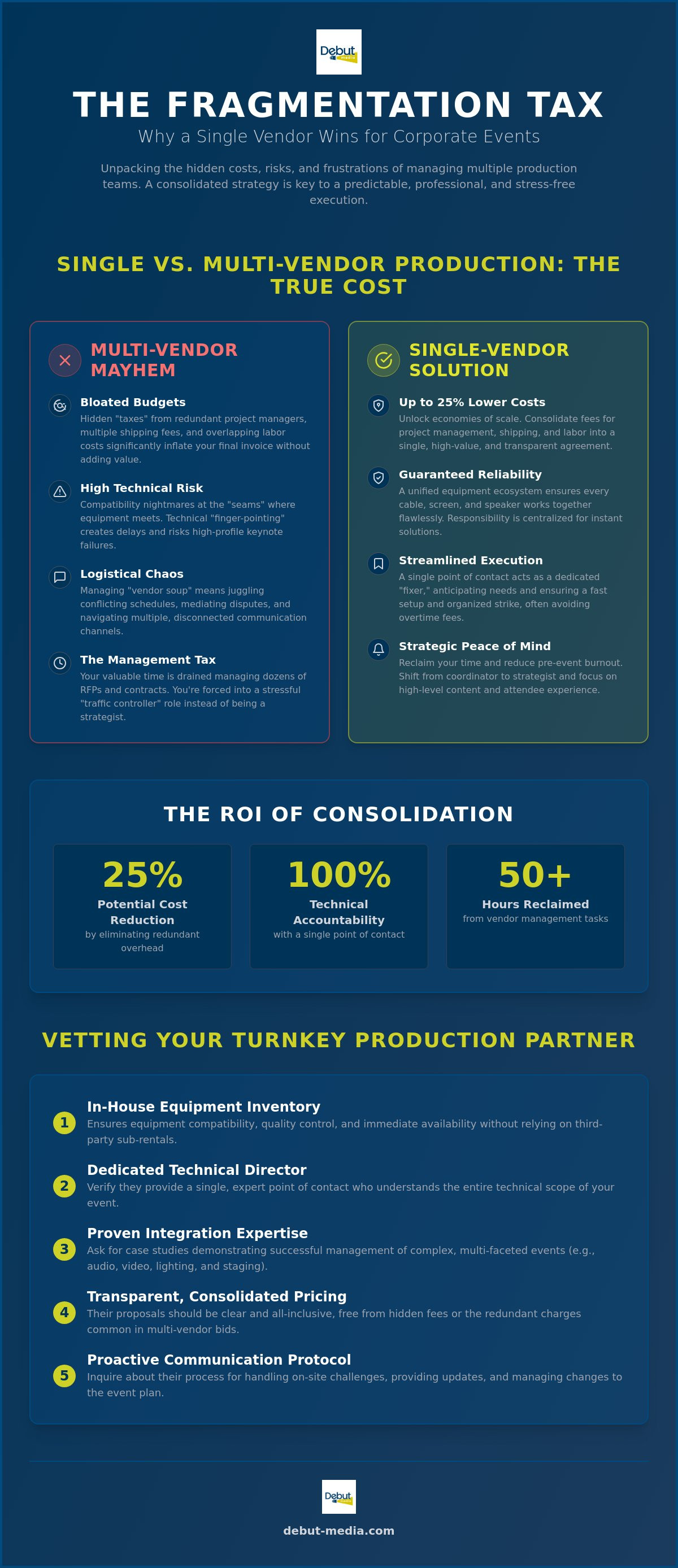
Vetting a Turnkey Production Partner: A 5-Point Checklist
Finding the right partner for single vendor event production is about moving from a transactional relationship to a strategic partnership. You need a team that doesn't just show up with gear but acts as a master coordinator for your entire vision. This transition requires a rigorous vetting process to ensure your chosen provider has the depth to handle complex, moving parts without dropping the ball. A reliable partner acts as your steady hand, but that stability is only possible if they control every link in the technical chain.
Use this 5-point checklist to verify that your prospective partner is a true specialist rather than a broker of sub-contracted services:
In-House Capabilities: Verify if the team performing the work are full-time employees or temporary gig workers hired for the day.
Technical Inventory Depth: Confirm they own a comprehensive range of sound, video, and lighting equipment to avoid third-party rental delays.
Logistical Background: Assess their experience in meeting planning and travel logistics to ensure they understand the "big picture."
Communication Infrastructure: Review the project management tools they use to keep you informed and maintain transparency throughout the planning process.
Technical Capability Assessment
A true single vendor owns their equipment and employs their crew. This ownership is the only way to guarantee quality control and equipment reliability. When you vet a partner, ask about their redundancy standards. Do they have backup projectors and audio consoles on-site? If a vendor sub-rents their gear, they lose the ability to verify its maintenance history, which introduces unnecessary risk into your production. Choosing single vendor event production with a partner who maintains their own inventory ensures that every piece of gear is show-ready and compatible with the rest of the ecosystem.
Logistical and Planning Depth
High-level production extends well beyond the stage. A comprehensive partner provides expert oversight for meeting planning and trade show & expo support. In 2026, the complexity of event regulations and venue requirements demands a team that understands more than just signal flow. They must manage the full lifecycle, including the high-pressure event equipment strike, ensuring the venue is cleared on time and without damages. This level of detail is what separates a basic equipment provider from a master coordinator. If you're ready to eliminate logistical friction and secure a "fixer" for your next event, contact Debut Media today for a consultation.
Consolidation in Action: Seamless Execution with Debut Media
At Debut Media, we don't believe in the "vendor soup" that often complicates corporate productions. We provide a unified technical ecosystem where every specialist works toward a single goal: your event's success. By integrating audio visual services, lighting, and event management into one turnkey solution, we remove the layers of communication that typically lead to errors. This integrated approach ensures that every piece of technology and every member of our crew moves in perfect harmony from the initial planning phase to the final equipment strike.
Our in-house specialists are the primary tool for eliminating logistical friction. We act as a master coordinator for national corporate clients who need a reliable, one-stop resource. Whether you're planning a series of regional seminars or a high-profile national gala, our team ensures your brand standards remain consistent across every venue. We handle the technical details so you can focus on your high-level objectives. This partnership model replaces the transactional nature of equipment rentals with the reliability of expert oversight.
A Stabilizing Force for Your Next Event
The emotional relief of efficiency is a cornerstone of our service. We position ourselves as a stabilizing force in a complex industry, providing the peace of mind that comes from knowing a "fixer" is always on-site. Our approach is a true partnership. We don't just supply gear; we provide a steady hand for planners who may feel overwhelmed by technical complexity. As you prepare your 2026 event calendar, a consolidated strategy is the most effective way to protect your budget and ensure a flawless attendee experience. We take the guesswork out of production, allowing you to walk into your venue with total confidence.
Your Single Point of Contact
Transitioning to a more efficient model starts with understanding your current technical needs. We offer a comprehensive production audit to identify where fragmentation might be draining your resources or increasing your risk. This process allows us to tailor our single vendor event production services to your specific goals, ensuring every dollar spent contributes to a more professional polish. It's time to move away from the stress of multi-vendor coordination and embrace a more streamlined future. Streamline your event production with Debut Media and experience the difference that a unified team makes for your next corporate engagement.
Secure a Flawless Technical Future for Your Events
Choosing a single vendor event production strategy is more than a budgetary decision; it's a commitment to operational excellence. By eliminating the administrative bloat of multiple contracts and the technical risks of incompatible gear, you place your production on a stable foundation. A unified approach reduces shipping delays, simplifies labor schedules, and provides the emotional relief of having a single master coordinator on-site. This model ensures your brand's voice remains clear and consistent from the first keynote to the final equipment strike.
You don't have to navigate the complexities of 2026 technical requirements alone. Debut Media offers national service capability with a single point of contact and a specialized technical crew. Our high-end inventory and comprehensive turnkey solutions for AV, lighting, and management are designed to act as your steady hand. Partner with Debut Media for your next corporate event to experience a production lifecycle that is efficient, predictable, and professional. We're ready to help you turn your next seminar or gala into a seamless success.
Frequently Asked Questions
What is single vendor event production?
It's a consolidated approach where one company manages every technical and logistical aspect of an event. This includes audio, video, lighting, and management services. By centralizing these functions, you eliminate the need to coordinate between multiple disjointed providers. This model creates a seamless technical environment where every piece of equipment works together perfectly.
Is a single vendor more expensive than hiring multiple specialists?
Consolidating your needs often reduces the total cost of ownership by eliminating redundant fees. While individual line items might vary, you avoid paying for multiple trucking companies, separate project management teams, and overlapping labor calls. Bundling these services typically provides better overall value and more predictable pricing for corporate budgets.
Can one company really handle audio, video, lighting, and management?
Yes, provided the company employs in-house specialists and maintains its own equipment inventory. A master coordinator manages these departments as a single, integrated unit. This ensures that the audio team knows exactly what the video team needs for signal flow. It prevents the communication breakdowns that often occur when separate companies try to share a limited workspace.
What are the risks of using multiple vendors for a corporate event?
The primary risks include fragmented accountability and technical incompatibility. If a glitch occurs, disparate teams often engage in "finger-pointing" instead of finding a solution. Multiple vendors also create logistical friction, such as dock congestion during load-in and conflicting setup schedules. These hurdles increase the likelihood of a technical failure during a high-stakes keynote or presentation.
How does a single vendor model simplify event logistics?
It replaces a committee of vendor leads with a single point of contact for all technical needs. Single vendor event production streamlines the entire lifecycle, from contracting and legal reviews to the final equipment strike. You manage one transport schedule and one labor team. This reduction in moving parts allows you to focus on your attendees while your partner handles the technical complexity.
What questions should I ask when vetting a turnkey production partner?
Start by asking if they own their equipment and employ their crew full-time. You should also inquire about their redundancy plans for critical systems like audio consoles and projectors. Ask for specific examples of how they handle trade show & expo support or national-scale logistics. A true partner will provide a detailed line-item breakdown and a clear plan for managing cross-departmental needs.
Is the single vendor model suitable for large-scale national conferences?
This model is preferred for large-scale conferences because it ensures brand consistency across multiple rooms or cities. Managing a national tour or a multi-day conference is significantly easier when you have one unified "brain" behind the curtain. It allows for a standardized technical setup that reduces the risk of errors as the event footprint expands.
How does Debut Media handle technical glitches during a live event?
We act as a steady hand by maintaining on-site redundancy and a proactive technical team. Because our specialists manage the entire ecosystem, they can identify and resolve issues before they impact the guest experience. Our project managers serve as the "fixer" for any unexpected hurdle. This centralized oversight ensures that solutions are implemented instantly without the delays of cross-vendor coordination.


