
2026 Guide to Flawless Corporate Town Hall AV
- 1 day ago
- 11 min read
Why does the most important meeting of the quarter often suffer from the worst production quality? You've likely experienced a session where leadership's vision was undermined by piercing audio feedback or muffled sound. When you are responsible for coordinating AV for corporate town hall meetings, the stakes are high. Every technical glitch creates a psychological distance between the executive team and the workforce, making your most vital communications feel unpolished.
We understand that managing these events is often a source of significant anxiety, especially when remote employees end up feeling like second-class participants. This guide provides a reliable framework to eliminate that friction and convert any office space into a professional broadcast studio. You'll learn exactly how to design and manage a seamless operation that ensures every employee hears and sees your message with total clarity. We will break down essential microphone and video requirements while showing you how to maintain expert oversight over every moving part, from initial setup to the final equipment strike.
Table of Contents
Defining the 2026 Standard for Corporate Town Hall AV
The corporate landscape has moved past the era of grainy webcams and "can you hear me" introductions. In 2026, the standard for a successful gathering is high-definition clarity and real-time interaction. Modern Audiovisual (AV) technology has transformed the traditional one-way lecture into a dynamic, multi-directional dialogue. Whether you are delivering a leadership update or hosting a celebratory gala, the technical execution of your AV for corporate town hall meetings directly reflects your brand's authority. If the technology falters, the message loses its impact.
Establishing clear goals is the first step in the planning process. A Q&A session requires different microphone configurations than a high-energy keynote or a national awards ceremony. Professional audio visual services ensure that these goals aren't just met, but amplified through intentional design. This shift toward broadcast-quality production isn't just about aesthetics; it's about making sure your leadership team is perceived as organized, capable, and connected to the workforce.
In-Person vs. Hybrid: The Dual Audience Challenge
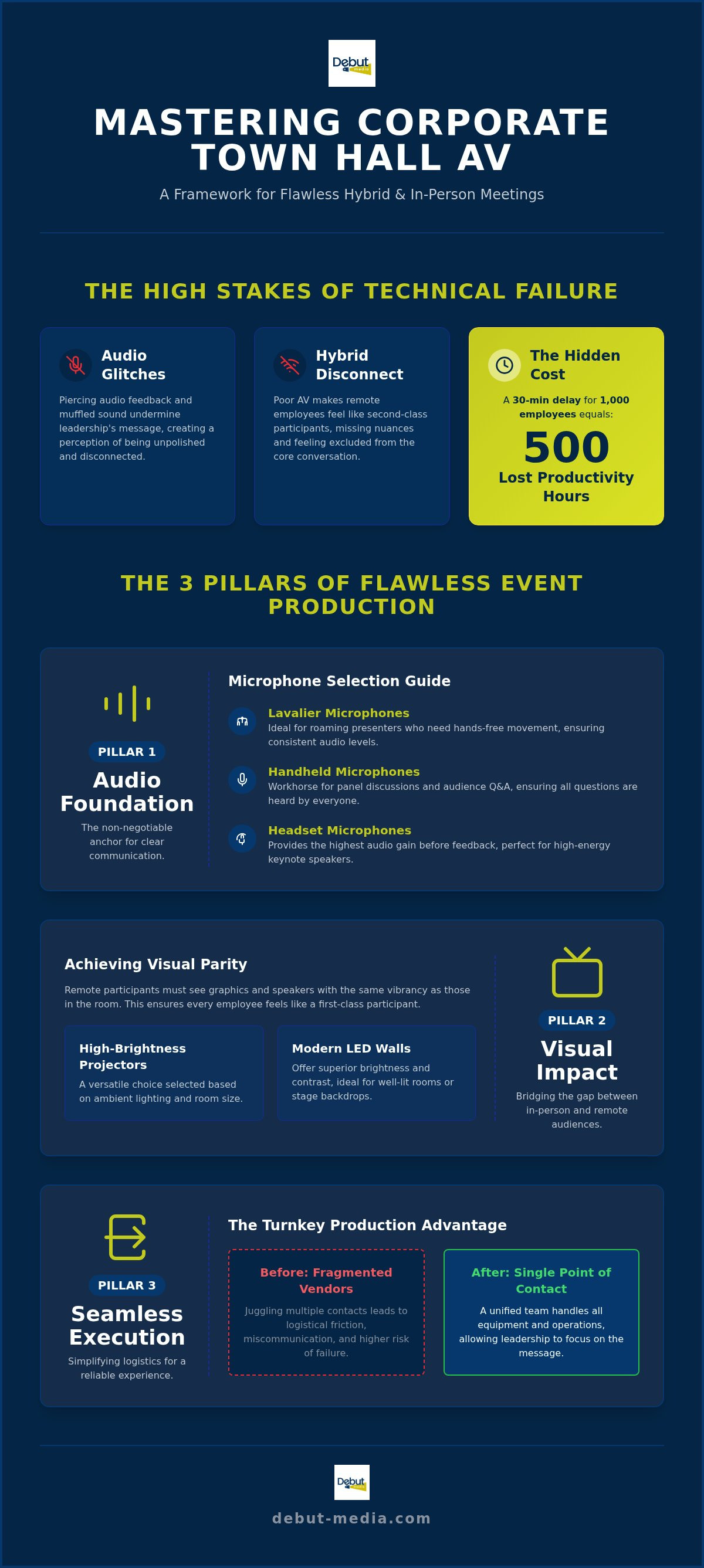
Designing for two audiences simultaneously is the most common hurdle for event planners. Audio that sounds "good enough" for the people sitting in the front row is often completely unusable for remote viewers. Without a dedicated broadcast mix, those joining from home miss the nuances of leadership speeches. You need visual parity, too. Remote participants should see high-impact graphics and speaker close-ups with the same vibrancy as those in the room. Bridging this gap involves integrating digital Q&A tools and live polls, ensuring every employee feels like a first-class participant regardless of their physical location.
The ROI of Professional Event Production
Technical failure isn't just embarrassing; it's expensive. If you have 1,000 employees waiting for a fix during a thirty-minute delay, you've lost 500 hours of collective productivity. High-quality production acts as a stabilizing force that prevents these costly interruptions. Beyond avoiding disaster, professional execution significantly boosts employee engagement and retention. When people can see and hear clearly, they stay focused. They feel valued.
Working with a dedicated partner rather than a fragmented group of vendors provides the peace of mind that allows leadership to focus on the message while the technical team handles the moving parts. This transition from a transactional vendor to a strategic partnership is what defines the modern standard for corporate communications. It's about replacing logistical friction with a seamless, reliable experience.
The Audio Foundation: Selecting the Right Microphone Rental for Conferences
Audio intelligibility is the non-negotiable anchor of any successful event. If your team can't hear the leadership's message clearly, the entire purpose of the gathering is lost. High-quality sound is a prerequisite for effective employee engagement. When planning your AV for corporate town hall meetings, the audio strategy must account for more than just volume. It requires precision in frequency management and equipment selection.
Modern corporate offices are often saturated with wireless signals from Wi-Fi routers and cellular devices. This creates a crowded RF (Radio Frequency) environment that can cause dropouts or static in wireless microphones. Professional frequency coordination ensures your mics operate on clean channels, avoiding interference that could ruin a keynote. This level of technical oversight is why a generic equipment rental isn't enough; you need a managed solution that accounts for your specific environment.
Choosing Microphones Based on Presenter Style
Lavalier microphones: These are ideal for roaming presenters who need hands-free movement. They clip onto clothing, allowing speakers to gesture naturally while maintaining a consistent audio level.
Handheld microphones: These are the workhorses of panel discussions. They are also essential for managing the Q&A nightmare. Having dedicated runners with handheld mics ensures that audience questions are heard by everyone, including remote viewers.
Headset microphones: These provide the highest gain before feedback. They are perfect for high-energy speakers who move their heads frequently, as the mic stays at a fixed distance from the mouth.
Advanced Audio Distribution for Large Venues
Large spaces like warehouses or open-plan atriums present unique acoustic challenges. Using a standard point-source speaker often results in hot spots near the stage and dead zones in the back. Line array systems solve this by projecting sound evenly across the entire floor. This ensures that the person in the last row has the same experience as the person in the first. It eliminates the frustration of muffled sound and echo.
Digital audio networking, specifically through Dante protocols, allows for clean and interference-free signal routing across long distances. This technology enables a dedicated audio engineer to link the room's sound directly to your livestream. This ensures that remote participants receive a crisp, direct feed rather than a hollow recording of the room's speakers. If you're feeling overwhelmed by these technical requirements, our team at Debut Media can help you design a custom audio package tailored to your specific office layout.
Visual Impact: Large Format Displays and Hybrid Integration
Visibility is the second pillar of professional AV for corporate town hall meetings. If an employee in the back row can't read the text on a slide or see the speaker's facial expressions, they've already checked out mentally. Calculating sightlines is a critical first step. A common rule of thumb is that the screen height should be at least one-sixth the distance to the furthest viewer. This ensures that your data remains legible and your message stays impactful for everyone in the room.
Choosing between LED walls and projectors depends largely on your venue's lighting. LED walls offer incredible brightness and contrast, making them perfect for sun-drenched atriums. However, integrating high-quality projectors for rent with high-definition video switchers remains a versatile and cost-effective solution for many ballroom setups. To bridge the gap in massive spaces, we utilize IMAG (Image Magnification). This technique puts a live close-up of your CEO on the big screen, humanizing the presentation and ensuring that leadership's presence is felt even in the last row.
Mastering the Visual Display Setup
Dual-screen configurations are the 2026 standard for high-level meetings. This setup keeps your content on one screen and the active speaker or remote participants on the other. It prevents the awkward "picture-in-picture" look that obscures vital data. When dealing with high levels of ambient light, high-lumen large venue projector rentals are essential to prevent washed-out images. We also pay strict attention to aspect ratios and resolution. Ensuring your graphics match the native resolution of your displays prevents the stretching or blurring that can make a professional presentation look amateur.
Hybrid Video Strategy: PTZ Cameras and Switchers
A professional broadcast requires more than a single static camera. Unobtrusive PTZ (Pan-Tilt-Zoom) cameras allow our technicians to capture multiple angles without bulky equipment or large crews distracting the audience. A video switcher is the heart of this operation, allowing for seamless transitions between live speakers, slide decks, and pre-recorded videos. Following best practices, such as those found in Boston University's hybrid meeting tech guide, ensures that your technical setup supports rather than distracts from the content. Finally, security is paramount. We prioritize encrypted streams and dedicated bandwidth to protect your internal corporate data from unauthorized access during the livestream.
Executing in Challenging Spaces: From Warehouses to Atriums
Many corporate headquarters feature stunning glass atriums or expansive warehouses that weren't designed with acoustics in mind. Converting these areas into a functional stage requires more than just setting up a few speakers. When you're coordinating AV for corporate town hall meetings in these non-traditional environments, you're essentially building a temporary broadcast studio from the ground up. This process requires a deep understanding of how physical space impacts technical performance.
One of the most common oversights in venue conversion is power distribution. A professional production rig including LED walls, high-output speakers, and video switchers can easily overwhelm standard 15-amp wall outlets. We often bring in dedicated power distribution units to ensure the system remains stable throughout the entire presentation. This prevents the nightmare scenario of a circuit breaker tripping mid-speech because the lighting and audio were sharing the same circuit.
Once the applause fades, the focus shifts to restoring your workspace. Utilizing professional event equipment strike services ensures a fast, organized removal of all gear. This allows your team to return to their normal routine without navigating a maze of cables and cases. If your next meeting is in a challenging venue, contact Debut Media to discuss our turnkey conversion solutions.
Acoustic Treatment and Sound Containment
Large, open spaces are notorious for echoes caused by hard surfaces and high ceilings. We use heavy pipe and drape to dampen these reflections and provide a clean, professional backdrop for the cameras. Strategic speaker placement is equally important to focus sound on the audience while minimizing bleed into nearby workstations. Digital signal processing (DSP) allows our engineers to surgically correct room-specific audio issues by adjusting frequencies to match the unique footprint of the space.
Logistical Management and On-Site Operation
Success in a cafeteria or lobby depends on a rigid corporate town hall AV setup schedule. This begins with a detailed load-in plan coordinated with your facilities and security teams to avoid blocked hallways or elevator delays. Rehearsals are non-negotiable; we insist on a full technical run-through at least one hour before doors open. During the event, having a dedicated technician for audio, video, and streaming removes the burden from your shoulders. This departmentalized approach ensures that if a presenter's slide deck needs a last-minute adjustment, the audio and livestream feeds remain uninterrupted.
Simplifying Success: Turnkey Production Solutions from Debut Media
Managing AV for corporate town hall meetings shouldn't feel like a second job for your communications team. When you fragment your production across multiple vendors, you invite unnecessary risks and technical gaps. A single point of contact approach replaces that chaos with a streamlined, methodical workflow. At Debut Media, we act as the stabilizing force that coordinates every moving part, from the initial wireless frequency scan to the final equipment strike.
Consistency is the hallmark of a professional broadcast. Because we utilize our own in-house technical crew, you don't have to worry about the "luck of the draw" with local freelancers. Our team understands our equipment inventory and our high standards for audio intelligibility and visual impact. This reliability is what allows your leadership team to step onto the stage with total confidence, knowing the technical foundation is secure.
The Stabilizing Force in Event Planning
We focus on reducing event logistical friction by handling the complex details of travel, equipment transport, and on-site management. Our process is designed for clarity. We begin with a thorough consultation to identify your specific goals, followed by a custom technical design. For example, we recently converted a glass-walled corporate lobby into a broadcast-ready town hall space by managing the power distribution and acoustic dampening required to make that non-traditional venue work. We stay with you through every phase, ensuring a seamless transition from setup to operation.
National Reach with a Personal Touch
Whether your headquarters is in New York, Chicago, or Los Angeles, our national reach ensures consistent quality across your entire 2026 town hall series. We provide customizable rental packages for seminars, conferences, and galas that adapt to your specific venue needs. You get the benefits of a large-scale production company with the personal touch of a dedicated project manager who knows your brand's requirements. Contact Debut Media today to simplify your next town hall production.
Elevating Your Corporate Communications for 2026
Your town hall serves as the most direct link between leadership and the workforce. Ensuring this connection remains unbroken requires a shift from basic equipment rentals to a managed production strategy. By prioritizing audio intelligibility and visual parity for your hybrid audience, you eliminate the distance that often plagues large-scale meetings. Whether you're converting a warehouse or hosting in a glass-walled atrium, the technical execution must be invisible so your message remains the focus.
Debut Media acts as your stabilizing force. We provide expert on-site technical operation and a single point of contact for all logistics, backed by a comprehensive inventory of high-end audio and video gear. It's time to replace logistical anxiety with the peace of mind that comes from professional oversight. Streamline your next corporate town hall with Debut Media's turnkey AV solutions. Planning AV for corporate town hall meetings shouldn't be a source of stress. We're ready to help you deliver a flawless experience for every employee.
Frequently Asked Questions
What is the best microphone for a corporate town hall meeting?
The best microphone depends on the presenter's movement; however, a wireless lavalier or headset is typically preferred for hands-free delivery. These options allow leadership to gesture naturally while maintaining a consistent audio level for the audience. For panel discussions, high-quality handheld microphones are more effective for passing between speakers. Choosing the right mic ensures high intelligibility, which is the foundation of professional AV for corporate town hall meetings.
How much does it cost to rent AV equipment for a town hall?
Pricing for town hall AV depends on several factors including venue size, the number of attendees, and the complexity of the hybrid integration. Since every event has unique technical requirements, we provide custom quotes based on your specific equipment list and labor needs. Factors like the duration of the event and the need for specialized broadcast engineers will also influence the final investment for your production.
Can you livestream a town hall meeting securely for internal employees only?
You can absolutely livestream a town hall meeting securely by using encrypted platforms that require SSO (Single Sign-On) or password protection. These tools ensure that sensitive corporate data remains accessible only to your internal employees. We focus on network segmentation and role-based access controls to prevent unauthorized viewing while maintaining a high-quality broadcast for your remote workforce across the country.
How do I handle audience Q&A in a large hybrid meeting space?
Managing Q&A in a large hybrid space is best handled by a combination of dedicated microphone runners and digital interaction tools. Using handheld microphones in the room ensures that remote participants can hear the questions clearly. Digital platforms allow both in-person and remote staff to submit questions in real-time, which a moderator can then relay to leadership to maintain a cohesive and inclusive dialogue.
What are the power requirements for a professional AV setup in an office?
Professional AV for corporate town hall meetings often requires dedicated power distribution rather than standard office wall outlets. A full production rig with LED walls, audio racks, and video switchers can easily exceed the capacity of a typical 15-amp circuit. We assess the venue's electrical infrastructure during the planning phase to ensure we have enough isolated power to prevent technical interruptions or circuit overloads during the live event.
How long does it take to set up and strike AV equipment for a town hall?
Setup for a standard corporate town hall typically takes between four and eight hours, while the strike is usually completed in two to three hours. The exact timeline depends on the complexity of the venue conversion and the amount of equipment involved. We coordinate closely with your facilities team to ensure the load-in and load-out schedules don't disrupt your daily office operations or employee productivity.
Do I need a separate audio engineer for my corporate event?
A dedicated audio engineer is vital for events that involve more than two microphones or a hybrid audience. This specialist manages the sound for the room while simultaneously creating a separate broadcast mix for remote viewers. Having an expert on-site removes the risk of audio feedback and ensures that every participant, regardless of their location, hears a crisp and balanced signal throughout the entire presentation.
What is the difference between a line array and standard speakers for a warehouse meeting?
A line array system is designed to provide even sound coverage across a deep or wide space, whereas standard point-source speakers are better for smaller, localized areas. In a warehouse or large atrium, a line array prevents the volume from being too loud in the front and too quiet in the back. This technology ensures that every employee experiences the same high-quality audio regardless of where they are standing in the venue.


