
Microphone Rental for Conferences: Plan Clear, Reliable Audio

Choosing the right microphone setup for a conference can be complex, as it varies for speakers, panelists, and audience members. The setup depends on participation and room arrangement.
This guide helps plan microphones for presentations, panels, and Q&A sessions, considering the venue and event format. It also covers integrated AV planning, technical setup, and on-site operation to simplify audio management, allowing you to focus on the event rather than the equipment in Raleigh, Durham, and Chapel Hill.
Table of Contents
Why Microphone Rental for Conferences Starts with Audience Coverage
Conference microphone rental involves integrating microphones into an event-specific audio plan, considering who needs to be heard, where they’ll speak, and the room's layout. A microphone is just one part of a coordinated sound system, so selecting a type alone doesn't ensure clear audio throughout the room.
Begin by mapping participation across the agenda. A keynote speaker may address the room from a main presentation area, while a seated panel requires a plan for multiple voices, ensuring each panelist is heard clearly. Audience Q&A introduces questions from various parts of the room. Plan for both speakers and listeners, not just the stage.
What conference formats change the microphone plan?
A single presenter, a seated panel, and audience participation each require different coverage. A stationary presenter differs from speakers in a discussion. For Q&A, determine how attendees will ask questions and ensure they are audible. Understanding microphone technology, including types and pickup patterns, is crucial for aligning choices with the speaking setup.
Room layout and event format influence microphone planning as each voice originates from a unique location.
Planners in Raleigh, Durham, and Chapel Hill benefit from coordinated microphone rental for conferences, which integrates equipment, technical setup, and on-site operation into a unified audio plan. This ensures microphone use aligns with session formats, room specifications, and the overall sound system.
How to Choose Conference Microphones for Speakers, Panels, and Q&A
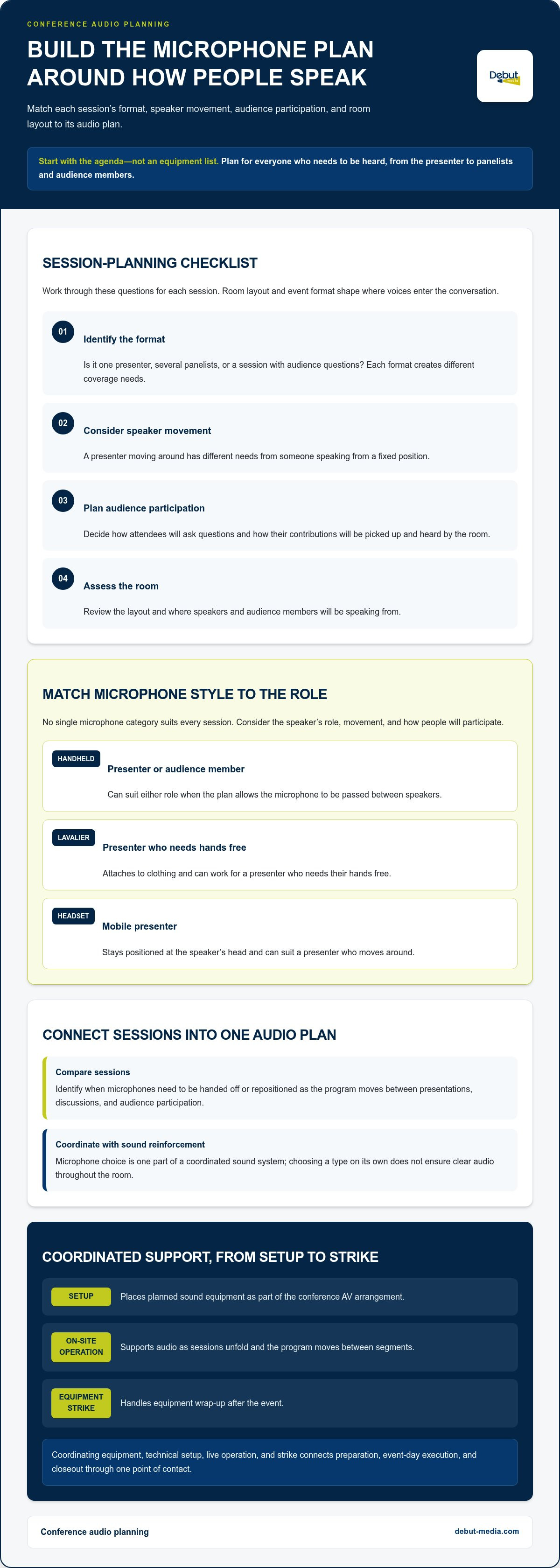
Build the microphone plan from the agenda, not from an equipment list. Work through these questions for each session:
Identify the format. Note whether the session features one presenter, several panelists, or audience questions.
Consider speaker movement. A presenter who moves around has different needs from someone speaking from a fixed position.
Plan audience participation. Decide how audience contributions will be picked up and included in the conversation.
Assess the room. Review the layout and where speakers and audience members will be speaking from.
Compare sessions to determine when microphones need to be handed off or repositioned, integrating microphone rental into a complete audio plan rather than a standalone choice.
Which microphone style suits each conference role?
A handheld microphone suits passing between speakers, a lavalier attaches to clothing for hands-free use, and a headset stays at the speaker’s head for mobility. Compare each microphone style based on the speaker’s role, movement, and delivery for presentations.
Choose microphone style according to the speaker’s role and the way people will participate. No single category suits every session. Consider the room, speaker movement, and how attendees will contribute.
A technical team manages microphone use and transitions between speakers to maintain audio alignment throughout the event. For coordinated conference AV planning, Debut Media AV and Production offers sound rental and technical support.
Coordinate Conference Microphone Rental and AV Support in the Triangle
Microphone rental for conferences is streamlined when integrated into the event-production plan. Debut Media manages sound equipment rental, setup, operation, and strike, providing a single contact for conference planners. This makes audio support part of the production workflow rather than a separate logistical task.
For events in Raleigh, Durham, and Chapel Hill, this method aligns microphone planning with conference AV. Discover how professional audio visual services and corporate event production can support a cohesive event plan.
What does coordinated microphone support cover on event day?
Setup integrates sound equipment into the conference AV arrangement. On-site operation manages audio during sessions, and equipment strike wraps up post-event. These stages ensure seamless preparation, execution, and closeout without the organizer managing each part separately.
A single contact aligns audio with other production needs through presentations, discussions, and audience participation. Debut Media’s integrated approach reduces coordination friction for planners across the Triangle.
For a streamlined conference plan, plan conference AV support with Debut Media.
Make Clear Conference Audio Part of the Plan
Effective conference audio requires aligning microphone coverage with how participants speak and interact, considering the different needs of keynotes, panels, and audience Q&A. Focus on speaker roles, movement, and room coverage instead of just microphone selection.
Coordinated technical support with microphone rental simplifies behind-the-scenes work. Debut Media provides sound rental, technical setup, on-site operation, and equipment strike, offering a single point of contact for integrated AV and event production in Raleigh, Durham, and Chapel Hill.
With a clear plan and coordinated support, you can concentrate on attendees and the valuable conversations at your conference.
Frequently Asked Questions
Is renting microphones for a conference better than relying on the venue's setup?
Neither option is inherently superior; the best choice depends on the event format, room, and production plan. Coordinated rental aligns microphones with presentations, panels, and audience participation, offering technical support for setup and operation. In Raleigh, Durham, and Chapel Hill, Debut Media integrates sound rental with broader AV production needs.
What type of microphone is best for a conference speaker?
No single microphone style suits every speaker or session. A handheld microphone may fit a presenter or audience Q&A, while a lavalier or headset may suit a presenter who needs their hands free or moves during delivery. Choose according to the speaker’s role, movement, and session format, then coordinate microphone use with sound coverage across the room.
How many microphones does a conference need?
The number depends on how many people speak at once and how the program is structured, not attendance alone. Start with the agenda: a keynote, panel discussion, and audience Q&A may each call for a different arrangement. For microphone rental for conferences, review who speaks during each session and plan equipment and operation around those moments.
Can conference microphones support audience Q&A?
Yes. Audience questions can be built into the conference audio plan. Decide how attendees will participate and how their questions will be heard throughout the room. If remote attendees are part of the event, include their listening needs in the production plan as well. A technical team can coordinate microphone use and transitions so Q&A fits smoothly into the program.


