
Professional Lighting for Corporate Events: Planning Guide
What if the best event lighting is the kind your audience barely notices? Professional lighting for corporate events should support each moment, not compete with speakers or presentations. A keynote needs clear visibility, while networking calls for a different atmosphere. When lighting follows the agenda, the room feels polished and the program stays in focus.
To choose an approach, start with the venue, the event schedule, and what attendees need to see. Consider screen placement, daylight, audience movement, and how the room will shift between presentations and networking. Debut Media AV and Production coordinates lighting with sound, video, and presentations for corporate events in Raleigh, Durham, and Chapel Hill, helping organizers keep production decisions connected.
Key Takeaways
Match lighting to the event’s purpose and agenda so presentations, networking, and recognition moments each feel appropriate.
Plan professional lighting for corporate events by reviewing the room, audience movement, speakers, screens, and key moments.
Prioritize visibility for presenters and attendees, while avoiding lighting that distracts from the program or interferes with screen viewing.
Coordinate lighting with audio, video, and event management through one production team for events in Raleigh, Durham, and Chapel Hill.
Table of Contents
What professional lighting for corporate events should accomplish
Professional event lighting is planned illumination that helps people see clearly, sets an appropriate atmosphere, and draws attention to key moments. It should serve the program, not compete with it. For corporate events, that means considering how the room needs to function as the agenda moves from presentations to networking or recognition.
Lighting has both a practical role and a visual one. Attendees need to see speakers, screens, and one another, while shifts in atmosphere can help distinguish one part of the event from another. The fundamentals of stage lighting offer useful context, but a corporate plan should be shaped by the room, the audience, and the event’s goals.
How event purpose shapes the lighting plan
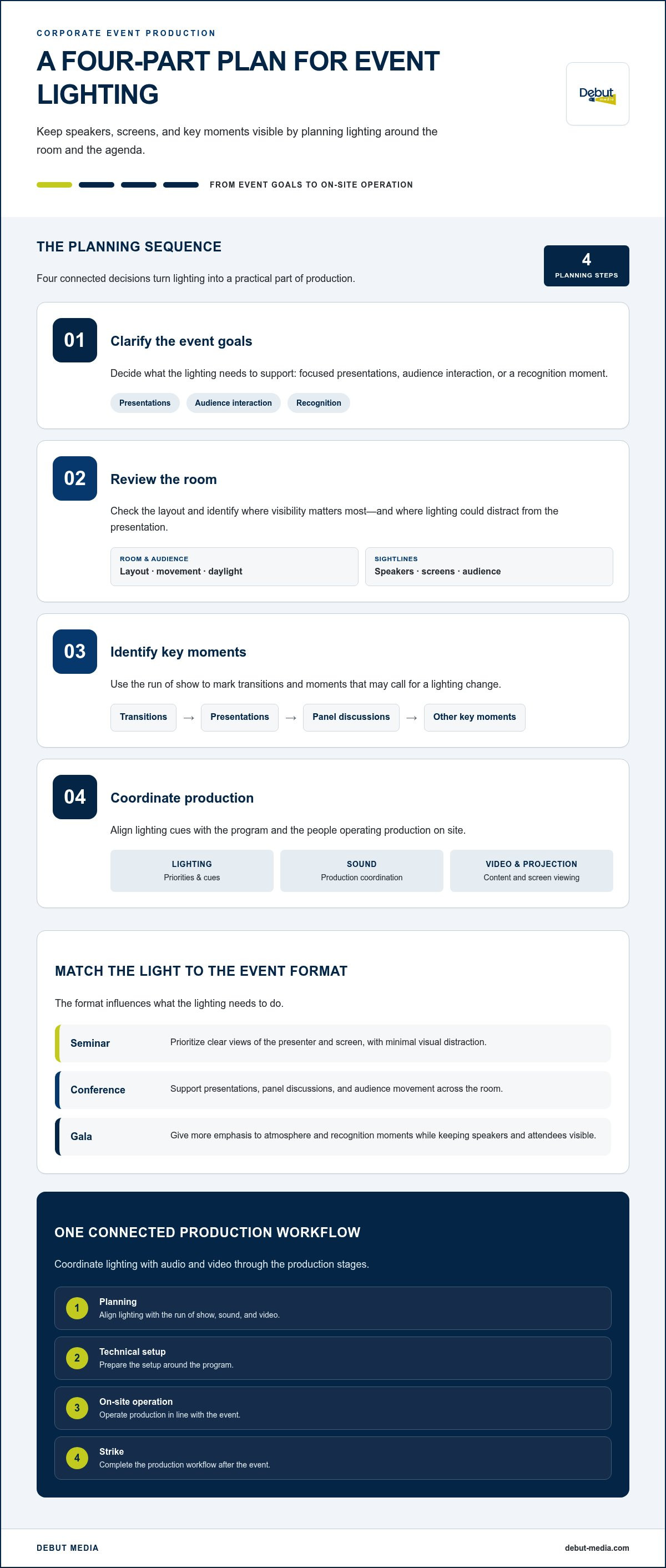
A seminar may prioritize clear views of the presenter and screen, with minimal visual distraction. A conference may need lighting that works across presentations, panel discussions, and audience movement. A gala may place more emphasis on atmosphere and recognition moments, while keeping speakers and attendees visible.
Start by identifying what people need to see and where they’ll be looking. Consider speaker positions, screen placement, and audience sightlines together. Check whether daylight or existing room lighting could make a screen harder to view. Lighting that pulls attention away from presentation content can make the program harder to follow; lighting that leaves a presenter or recognition moment visually unsupported can weaken its impact.
Professional lighting for corporate events should follow the agenda rather than rely on one static look. Mapping lighting needs to key moments helps create a cohesive experience while keeping visibility at the center.
How to plan professional corporate event lighting step by step
A clear plan makes professional lighting for corporate events a practical part of production, rather than a last-minute addition. Use this sequence to set priorities:
Clarify the event goals. Decide what the lighting needs to support, such as focused presentations, audience interaction, or a recognition moment.
Review the room. Consider the layout, daylight, audience movement, speaker positions, and screen placement. Note where visibility matters most and where lighting could distract from the presentation.
Identify key moments. Use the run of show to note transitions, presentations, panel discussions, and other moments that may call for a lighting change.
Coordinate production. Align the lighting plan with sound, video, projection, and the people operating the production on site.
Plan lighting by clarifying the event goals, reviewing the room, identifying key moments, and coordinating production needs. The event format helps shape each decision. A presentation-led program may prioritize speaker and screen visibility, while sessions with audience movement need lighting that works across different parts of the room.
What to align before production begins
Connect lighting priorities and cues to the run of show and presentation content. For example, plan a transition around a speaker change or a new presentation segment so the lighting supports the program instead of drawing attention away from it. Review those cues alongside sound, video, and projection, and align them with on-site technical operation.
For a broader view of how these production elements work together, explore Debut Media’s corporate AV production services. Debut Media coordinates event production through one in-house team, helping keep planning and communication connected. Explore coordinated event production as part of your planning.
Coordinating event lighting with production in Raleigh, Durham, and Chapel Hill
Lighting works best when it’s planned alongside the rest of the event production. Audio, video, presentations, and event management all affect how the program runs. Coordinating these elements through one production team keeps decisions connected, so a change to the run of show can be shared with the people responsible for the relevant production needs.
For corporate events in Raleigh, Durham, Chapel Hill, and throughout North Carolina, Debut Media coordinates lighting with event AV production. The plan carries through technical setup, on-site operation, and strike, helping organizers manage connected production needs from preparation through the end of the event.
What coordinated lighting support can simplify
Think of planning, setup, operation, and strike as connected stages. The production team can align lighting with audio and video during planning, prepare the technical setup around the program, and operate the production on site. After the event, strike completes the workflow. With one point of contact, organizers have a clear path for sharing updates and coordinating production details.
For more context on how the moving parts fit together, read the corporate event production guide. If you're planning professional lighting for corporate events in Raleigh, Durham, or Chapel Hill, an integrated production approach can simplify coordination. Start planning your event production with Debut Media.
Bring your event lighting plan together
Professional lighting for corporate events should support the agenda, keep speakers and presentations visible, and help the room feel right for each moment. Start with the event’s goals, review the venue and audience layout, then identify key moments that may need a lighting change. Align those priorities with sound, video, and the run of show.
Debut Media coordinates lighting with corporate event AV production, including planning, technical setup, on-site operation, and strike. With one point of contact, organizers can keep production decisions connected for events in Raleigh, Durham, Chapel Hill, and across North Carolina.
Bring your agenda, venue details, and production priorities together with Debut Media to plan lighting that supports the experience you want guests to have.
Frequently Asked Questions
What does professional lighting for a corporate event include?
Professional lighting for a corporate event can include planning for visibility, atmosphere, speakers, presentations, and important moments such as transitions or recognition. The approach depends on the agenda and the room, including how people will use the space. Debut Media coordinates lighting with sound and video as part of corporate event AV production.
How do I choose lighting for a corporate event?
Start with the event’s purpose and run of show. Then consider the room layout, audience movement, speaker positions, screens, daylight, and moments that need emphasis. These details help shape professional lighting for corporate events around the specific program and venue. Coordinating lighting with sound and video keeps the production plan connected to the event.
Can event lighting be coordinated with audio and video?
Yes. Lighting can be planned alongside sound, video, and projection so production supports the agenda as a whole. Shared planning helps align transitions and clarify how each element fits the program, while on-site technical operation keeps production coordinated. For events in Raleigh, Durham, and Chapel Hill, Debut Media brings these production elements together through one team.
How far in advance should I plan corporate event lighting?
Planning time depends on the event’s scope, schedule, and production needs, so there isn’t one lead time that fits every event. Include lighting early in your planning, alongside AV decisions and the agenda, to connect production requirements as they take shape. Debut Media coordinates production around each project’s event plan.


