
Outsourced Event Management vs. In-House: The 2026 Strategy Guide for Corporate Success
What if the "cost-saving" decision to keep your next conference internal is actually the most expensive mistake your department makes this year? Most corporate leaders feel the pressure to do more with less, often tasking marketing or HR teams with "double-hatting" as event planners. It's a heavy burden that leads to burnout and, far too often, technical glitches that happen right when the CEO steps on stage. When weighing outsourced event management vs in-house teams, the decision isn't just about a line item on a spreadsheet. It's about protecting your brand's reputation and your team's sanity.
You already know that a successful event requires more than just a booked room and a slide deck. You want a seamless, professional-grade production that impresses stakeholders and delivers a clear ROI without the logistical friction of managing twenty different vendors. This guide explores the critical trade-offs between internal coordination and external specialists. We will examine how to choose a model that provides the technical reliability and expert oversight your 2026 strategy demands, ensuring your next event is a stabilizing force for your business rather than a source of stress.
Table of Contents
In-House vs. Outsourced Event Management: Defining the 2026 Landscape
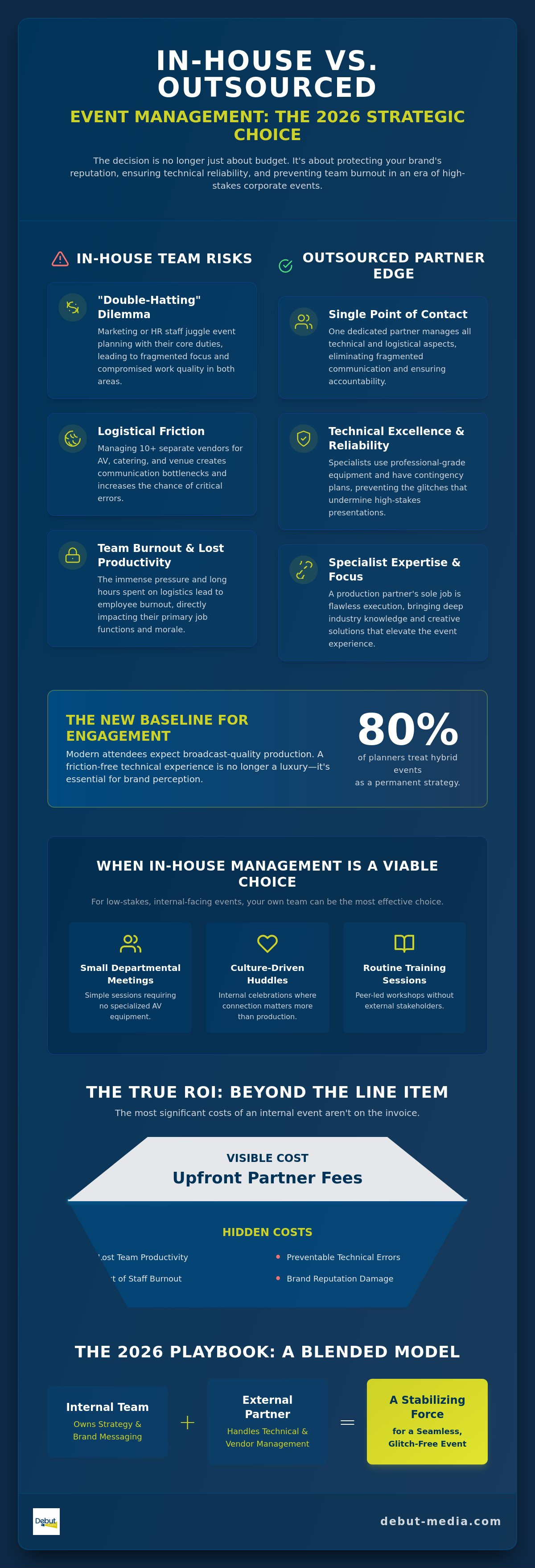
The decision between outsourced event management vs in-house coordination is no longer a simple matter of budget. In-house management involves leveraging your existing staff, usually from HR or Marketing, to handle event logistics alongside their daily responsibilities. Outsourced management means partnering with a professional production company that takes full ownership of the planning and technical execution. The standard for corporate success has shifted significantly. By 2026, the expectations for even routine meetings have reached a level where a dedicated specialist is often the only way to ensure a friction-free experience.
The Evolution of Corporate Event Expectations
Modern attendees don't just want information; they want an experience. A basic seminar now requires the same production quality as a live broadcast. This shift means that Event management is now intrinsically tied to technical excellence. If your video feed lags or the audio is muffled, engagement drops instantly. High-production values are the new baseline for brand perception. Research shows that 80% of planners now treat hybrid events as a permanent part of their strategy. This reality makes professional AV services and seamless streaming non-negotiable for high-impact corporate gatherings.
When In-House Management is a Viable Choice
Keeping management internal is often a practical choice for low-stakes environments. If your event is small, recurring, and technically simple, your internal team is likely the best fit. They understand your company culture and can manage casual employee engagement sessions with ease. This approach is effective for:
Small departmental meetings: Sessions that require no specialized equipment beyond a standard projector and screen.
Culture-driven huddles: Internal celebrations where the emotional connection matters more than the production value.
Routine training: Peer-led workshops that don't involve external stakeholders or high-pressure presentations.
The DIY approach works well until complexity enters the frame. Once you move toward external-facing conferences or multi-day galas, the strain on internal staff often leads to burnout and oversight. The "double-hatting" of roles can quickly become a liability when technical glitches occur during high-stakes moments.
The most effective 2026 strategies often utilize a blended model. Your internal team stays in control of the core strategy and brand messaging. Meanwhile, an external partner acts as a stabilizing force, handling the technical production and vendor management. This division of labor ensures that your staff can focus on their actual jobs while a professional fixer ensures the event runs without a single glitch. When comparing outsourced event management vs in-house options, remember that the goal is a seamless result that reflects your brand's authority.
The Hidden Strain: Risks of Internal Event Management
Assigning event logistics to internal teams often feels like a savvy cost-saving measure. However, the hidden strain of this approach frequently outweighs any perceived savings. When comparing outsourced event management vs in-house execution, the most immediate risk is the "double-hatting" dilemma. Your marketing or HR professionals are experts in their specific fields, not in managing complex event timelines. Forcing them to juggle their full-time roles alongside event planning creates a fragmented focus. This division of labor compromises their primary work and leads to preventable oversights in the event schedule.
Managing ten or more disparate vendors simultaneously introduces significant logistical friction. From catering and venue contracts to specialized technical requirements, the sheer volume of communication can overwhelm even the most organized internal staff. This often results in a "good enough" standard that falls short during high-stakes galas. Just as a reliable partner like Carolina IT Group manages a company's internal technology to prevent downtime, an event specialist prevents technical friction on the big stage. A single missed detail in a vendor contract or a miscommunicated load-in time can lead to a cascade of issues on the day of the event. These small glitches don't just cause stress; they directly undermine the professional image you want to project to stakeholders.
The Reality of Team Burnout and Productivity Loss
Calculating the opportunity cost is essential for corporate success. If your marketing team spends 40 hours on venue logistics, they aren't driving leads or refining your brand strategy. This productivity loss is a direct, though often invisible, cost to the business. The psychological toll is equally high. Non-specialized staff often experience intense pressure when managing high-stakes events, which frequently leads to burnout and a culture of last-minute crisis management. Understanding when and how to outsource event management allows your team to stay focused on their core strengths while specialists handle the heavy lifting.
Technical Vulnerability and Equipment Gaps
Technical vulnerability is perhaps the greatest risk of internal management. Relying on venue-provided AV without an independent technical advocate is a gamble that rarely pays off. Corporate departments don't usually possess the specialized expertise required for professional-grade lighting, sound, and video. Common failure points like audio feedback, projection lag, or poor lighting can ruin a presentation in seconds. True event production requires more than just renting a projector. It demands a comprehensive understanding of signal flow and technical backup plans that internal teams simply aren't equipped to provide. If your team is feeling the weight of these technical demands, a professional production partner can act as the stabilizing force you need to ensure a flawless execution.
The Outsourced Edge: Strategic Advantages of Professional Production
Choosing between outsourced event management vs in-house coordination often comes down to how much friction you're willing to tolerate. While internal teams struggle to juggle vendor lists, a professional production partner acts as a singular, organized entity. This "single point of contact" model eliminates the need for fragmented communication across a dozen different suppliers. Instead of spending your day chasing catering updates or checking electrical loads, you oversee a partnership. This shift allows you to focus on high-level strategy while a dedicated specialist handles the moving parts.
The most significant advantage of this model is the presence of a stabilizing force. Professional partners bring a "seen it all" perspective to the table. They don't just follow a checklist; they anticipate hurdles before they manifest as problems. This proactive approach transforms the event from a series of logistical tasks into a cohesive, high-impact experience. It provides the emotional relief of knowing that every detail is under expert oversight.
Consolidated Technical Mastery
One of the greatest efficiencies comes from having audio visual services and planning under one roof. In the 2026 corporate environment, technology is the backbone of engagement. Partnering with a specialist gives you access to cutting-edge production tools without the massive capital investment of buying equipment. You benefit from professional-grade sound, video, and lighting that internal teams simply cannot replicate with "off-the-shelf" solutions.
This mastery extends to the "first-in, last-out" burden. Internal staff often find themselves staying late for equipment strike or arriving hours early for setup. A professional team handles the entire lifecycle of the production. They manage the heavy lifting, the technical rigging, and the final strike, ensuring your team leaves the venue as soon as the final session concludes.
Risk Mitigation and the Fixer Mentality
High-stakes events like keynotes and award shows leave no room for error. When evaluating outsourced event management vs in-house options, consider the value of on-site technical operation. A professional partner acts as a "fixer," monitoring every signal and transition in real-time. They are equipped to handle the unexpected, from a last-minute slide change to a sudden wireless interference issue.
This level of reliability is essential for maintaining the confidence of C-suite executives and VIP speakers. When a speaker walks onto the stage, they need to know the technology will work perfectly. Having a technical expert at the booth provides a sense of security that venue-provided staff rarely offer. This expert oversight ensures a seamless experience that reflects your brand's authority and keeps the focus where it belongs: on your message.
Cost-Benefit Analysis: ROI Beyond the Line Item
Evaluating the true financial impact of outsourced event management vs in-house coordination requires looking past the management fee. While an internal team might appear "free" because they are already on the payroll, the indirect costs are often staggering. Every hour your marketing director spends sourcing a local caterer is an hour lost on revenue-generating strategy. This loss of focus, combined with the administrative burden of managing multiple contracts, creates a significant hidden expense that rarely appears on a standard budget sheet.
Consolidating these needs through a single vendor event production model drastically reduces this overhead. Instead of processing twenty separate invoices and coordinating ten different load-in schedules, you manage one partnership. This streamlined approach minimizes errors and ensures that every technical element, from the sound system to the custom graphics, works in perfect sync. The result is a more predictable cost structure and a massive reduction in the time your staff spends on logistical minutiae.
The Myth of the "Cheap" Internal Event
Internal events often suffer from "budget creep" caused by hidden expenses. Shipping specialized gear, paying for last-minute equipment rentals, and absorbing employee overtime can quickly erase any initial savings. With 88% of corporate event professionals anticipating higher budgets in 2026 according to industry reports, the pressure to spend wisely is at an all-time high. The financial impact of a technical failure during a product launch is far greater than the cost of a professional crew. When an event fails to deliver its message due to poor audio or lagging visuals, the investment in the venue and catering is essentially wasted.
Quantifying Professional Impact
Professional production adds value that an internal DIY approach cannot match. Specialized lighting and high-end graphic design aren't just aesthetic choices; they are tools that drive higher engagement, especially at crowded trade shows. Attendees in 2026 expect hyper-personalized and immersive experiences. Professionally managed events consistently see higher feedback scores because they eliminate the "technical friction" that distracts from the content. Event ROI is the intersection of technical flawlessness and goal achievement. If you want to ensure your next gathering hits its strategic targets without the typical stress, partnering with a turnkey production specialist is the most reliable path to success.
Choosing Your Model: How to Transition to a Production Partner
Making the final call on outsourced event management vs in-house execution requires an honest look at your 2026 calendar. You don't need a professional production team for every Friday afternoon huddle, but you do need one for the moments that define your brand. Start by categorizing your events into high-stakes and low-stakes groups. High-stakes events involve external stakeholders, VIP speakers, or complex technical requirements that could fail without expert oversight. For these gatherings, the reassurance of a stabilizing force is more than a luxury. It's a strategic necessity.
When vetting a potential partner, look for an entity that offers both management and in-house technical services. Many agencies outsource their own AV needs, which simply adds another layer of communication and potential friction. A true "one-stop" resource owns their equipment and employs their own technical crew. To see how a professional team handles these complexities, discover AMA Event Management and their comprehensive approach to event execution, ensuring that the person planning your timeline is in direct contact with the person operating the soundboard. This level of cohesion is what creates a truly stress-free environment for your internal team.
Steps to a Seamless Transition
Transitioning to an outsourced model should be a methodical process that removes obstacles rather than creating them. Follow these steps to ensure a smooth handover:
Audit current pain points: Identify exactly where your team struggled during previous events. Was it vendor communication, technical glitches, or the physical burden of setup?
Define the scope: Clearly outline what stays in-house, such as brand messaging and guest lists, and what goes to the partner, such as technical production and logistical management.
Set clear KPIs: Establish what success looks like beyond "no technical errors." This might include specific attendee engagement scores or a reduction in internal staff overtime hours.
The Debut Media Approach: Your One-Stop Resource
We act as the steady hand for your most important seminars, conferences, and galas. Our team understands that you aren't just looking for equipment rentals; you're looking for the peace of mind that comes from expert oversight. We eliminate the logistical friction that usually plagues corporate events by acting as your single point of contact for everything from the initial planning stages to the final equipment strike.
Our turnkey solutions are designed to support overwhelmed internal teams, allowing them to return to their core roles while we handle the technical heavy lifting. We've seen every possible scenario and have a plan ready for each one, ensuring your event remains professional, predictable, and high-impact. Ready to eliminate logistical friction? Contact Debut Media for a seamless event production strategy and discover how we can stabilize your next corporate gathering.
Elevate Your 2026 Event Strategy
Deciding between outsourced event management vs in-house coordination is a choice between logistical friction and professional stability. The technical demands of 2026 corporate gatherings require a level of mastery that most internal teams aren't equipped to provide on their own. By partnering with specialists, you eliminate the risk of team burnout and ensure that every high-stakes presentation lands with precision. This approach transforms your events from stressful hurdles into powerful tools for corporate growth and stakeholder engagement. If you are also looking to optimize your broader organizational outreach, visit Calls-Are-Us to learn more about their specialized communication services.
Debut Media provides a single point of contact for all AV and logistics, acting as a steady hand for your most important seminars and galas. Our specialized crew handles the technical operation on-site, offering turnkey solutions that cover everything from planning to equipment strike. Streamline your next event with Debut Media’s integrated production services and reclaim your team's time. You can move forward with the confidence that every detail is under expert oversight, ensuring a seamless and impressive experience for every attendee.
Frequently Asked Questions
Is it always more expensive to outsource event management?
It isn't always more expensive to outsource because you avoid the massive indirect costs of team burnout and lost productivity. When comparing outsourced event management vs in-house models, the management fee is often offset by industry leverage and the prevention of costly technical errors. You pay for the certainty of a successful outcome rather than risking a failed event that wastes your entire venue and catering budget.
What are the biggest risks of managing a corporate event in-house?
The most significant risks include technical failure during high-stakes presentations and the psychological toll on staff who must juggle multiple roles. In-house teams often lack the specialized AV expertise to handle unexpected signal interference or equipment glitches in real-time. This can lead to a "good enough" production that fails to impress stakeholders or, in worst-case scenarios, a complete breakdown of the event flow that damages your brand reputation.
Can we outsource just the technical AV and keep the planning in-house?
You can certainly outsource only the technical AV, but keeping the planning in-house often leaves your team stuck in the middle of logistical friction. A turnkey model that integrates both management and production provides a stabilizing force for the entire project. This approach ensures that the technical crew and the event planners are perfectly aligned, eliminating the communication gaps that occur when managing multiple disparate vendors.
How do I know if my event is 'complex' enough to require a professional partner?
Complexity is determined by the stakes and the technical requirements of your gathering. If your event involves external VIP speakers, C-suite executives, or a live hybrid stream, it requires a professional partner. Events that rely on seamless transitions and high-production values to maintain attendee engagement are too risky to manage with a DIY approach. If a single technical error would derail the event's goals, it's complex enough for specialists.
What does a single point of contact actually mean for my planning process?
A single point of contact means you communicate with one expert who oversees every moving part of your production. Instead of chasing a dozen different vendors for updates on catering, lighting, and sound, you receive consolidated reports from one source. This model removes the administrative burden from your internal team and replaces fragmented communication with a clear, organized progression that ensures every detail is handled correctly.
How does professional event production impact our brand image?
Professional production projects an image of authority, reliability, and attention to detail. When an event runs without a single glitch, it signals to your audience that your organization is highly organized and values their time. High-quality audio and visuals ensure your message is delivered clearly, which directly impacts brand perception and attendee engagement. It transforms a routine meeting into a polished, memorable experience that reflects your corporate standards.
What is included in professional event equipment strike services?
Equipment strike services include the methodical dismantling and removal of all technical gear immediately following your event. This process ensures the venue is cleared efficiently and returned to its original state without your staff needing to stay behind. A professional crew handles the heavy lifting, cable management, and logistics of the load-out, allowing your team to depart as soon as the final session concludes with total peace of mind.
How do I justify the cost of an event production company to my CFO?
You justify the investment by focusing on risk mitigation and the measurable ROI of a successful event. Highlight the opportunity cost of pulling your marketing or HR teams away from their primary roles to manage logistics. When analyzing outsourced event management vs in-house costs, explain that the fee is an insurance policy against technical failures. A flawless execution ensures the event actually achieves its strategic business objectives.


