
Streamlining Event Technology Management: Reducing Logistical Friction in 2026
Updated: Jul 16
Imagine you're five minutes from the opening keynote. The audio feed is silent, the presentation slides won't load, and the three different technical vendors on your headset are all pointing fingers at each other. It's a high-stakes moment that feels like it's slipping through your fingers. You shouldn't have to act as a technical referee while trying to run a world-class conference. Most event planners feel the weight of fragmented systems, where every new tool adds another layer of potential failure and hidden costs. With in-person events now costing nearly 48% more than virtual alternatives, the margin for technical error has never been thinner.
Success in 2026 requires a new approach. Streamlining event technology management isn't just about finding better software; it's about consolidating your entire production interface into a single, reliable point of contact. This article explains the strategic shift from managing dozens of disconnected tools to utilizing unified production systems that eliminate technical delays and logistical headaches. You'll learn how to replace technical friction with a predictable, scalable framework that ensures every presentation is flawless and every setup is efficient. We will walk through the transition from fragmented vendor management to a cohesive, expert-led partnership.
Table of Contents
The Evolution of Event Technology Management in 2026
Event technology management is the strategic orchestration of digital and physical tools to create a seamless attendee journey. In 2026, the corporate sector has moved past the phase of rapid tech adoption. We've entered the era of tech optimization. Planners no longer ask "What can this app do?" but "How does this app talk to my lighting rig?" This shift is a direct response to "Integration Fatigue," where the sheer volume of disconnected platforms has become a logistical burden rather than a benefit. It's a weight that many planners feel during the final weeks of production when tools should be helping, not hindering.
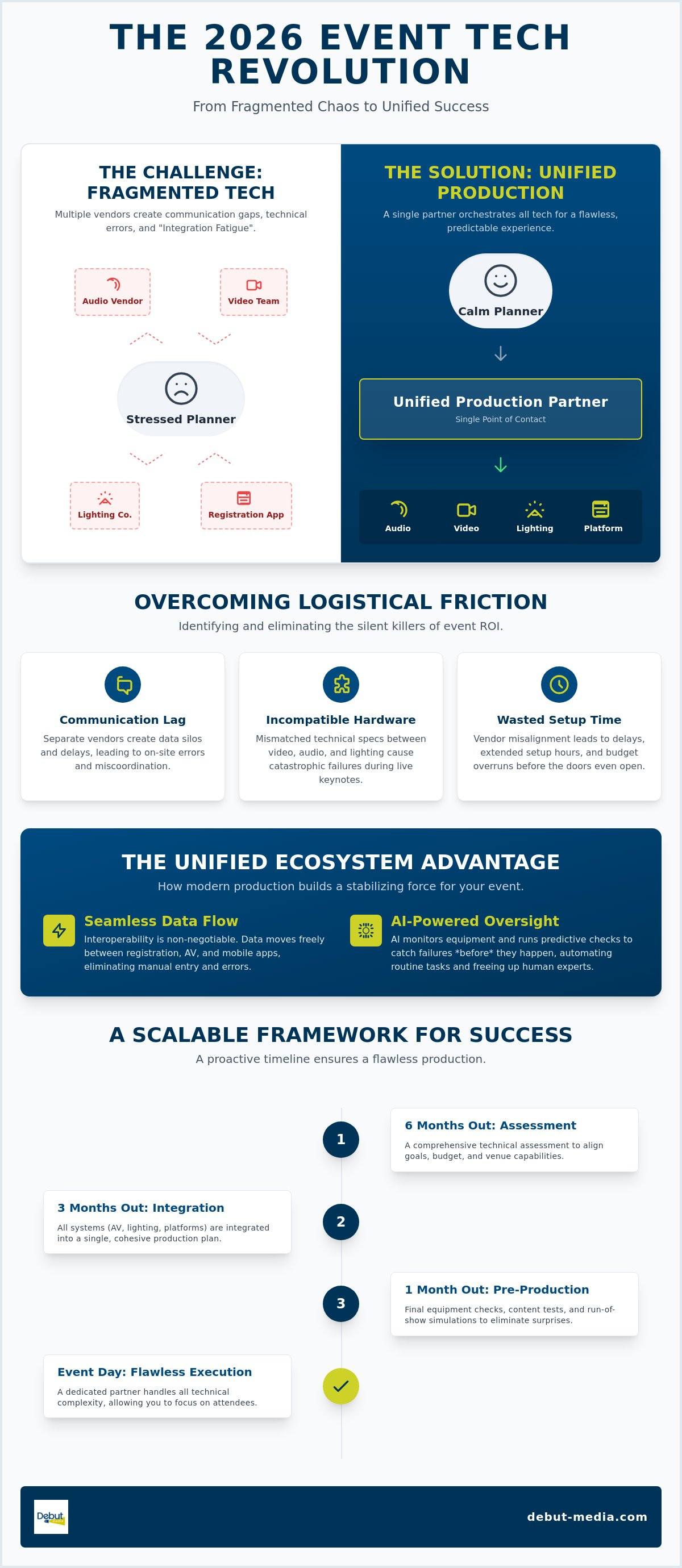
Modern Event management now requires a holistic production ecosystem. Instead of a fragile stack of independent apps, successful teams are building unified systems where data flows freely between registration, AV, and sound. This approach is central to streamlining event technology management, as it removes the friction of manual data entry and mismatched technical specs. By treating your technology as a single organism rather than a collection of parts, you create a stabilizing force that can handle the unexpected without causing a panic.
From Fragmented Tools to Unified Ecosystems
The "there is an app for that" mentality originally promised simplicity. Instead, it delivered fragmented workflows. Planners found themselves acting as human bridges between software that wouldn't sync, leading to exhaustion and missed details. In 2026, interoperability is a non-negotiable requirement for any serious production. Unified systems eliminate data silos, providing real-time reporting that actually helps you make decisions during the event. When your video switcher, lighting console, and mobile app share a single data backbone, the risk of error drops significantly. This cohesion turns a chaotic list of tasks into a manageable, linear process.
The Role of AI in Simplifying Technical Oversight
AI is the silent partner in modern production. It's no longer just about generating marketing copy or attendee bios. In 2026, we use AI for predictive technical checks and equipment monitoring to catch failures before they happen. Imagine a system that alerts your lead engineer that a projector bulb is likely to fail before the keynote even starts. AI-driven logistics is a tool for proactive problem-solving that automates routine tasks, such as tracking equipment transit or monitoring signal strength across a massive venue. This level of oversight provides the emotional relief of knowing the technical details are being watched by a system that doesn't get tired. It frees your human production leads to focus on the high-level experience rather than troubleshooting cables.
Identifying and Reducing Event Logistical Friction
Logistical friction is the silent killer of event ROI. It manifests as the invisible delays that occur when your digital registration platform doesn't sync with your on-site badge printing, or when the lighting crew waits on a power drop that the AV team forgot to request. These hand-off points are where the most significant technical delays occur. When you prioritize streamlining event technology management, you're essentially identifying these gaps and closing them before they impact the live experience. Friction isn't just an inconvenience; it's a financial drain that complicates every hour of your production schedule.
Technical silos lead to communication breakdowns that can ruin a high-stakes keynote. If the video team uses a specific codec that the playback hardware doesn't support, you're looking at a black screen while your speaker waits on stage. This isn't just a technical glitch. It's a failure of coordination. Addressing evolving technology demands for events means ensuring that every piece of hardware and software speaks the same language. Without this alignment, your attendees experience a disjointed event that lacks the professional polish your brand requires.
Common Friction Points in Modern Event Production
Multi-vendor communication lag is a primary source of friction. When you hire separate teams for sound, video, and lighting, you're often managing three different sets of technical requirements that may conflict. This leads to incompatible hardware interfaces during live execution. Perhaps the most damaging friction point is the "blame game." When a glitch occurs, separate vendors often point fingers at each other rather than solving the problem. This lack of ownership creates a high-stress environment for planners who just want the show to run smoothly.
Measuring the Impact of Technical Complexity
You can't fix what you don't measure. Start by auditing your current event tech stack for redundant features. Many planners pay for three different tools that all perform the same analytics function. Calculate the time-cost of managing multiple technical contracts and the administrative hours spent in "sync meetings" between different vendors. This audit often reveals that fragmented technology is skyrocketing your costs without adding value. You can find a clearer path forward by reducing event logistical friction through better planning and consolidation. Partnering with a comprehensive event management team can turn these disjointed efforts into a single, efficient workflow that protects your budget and your sanity.
The 2026 Strategy: Single-Vendor Production Partnerships
The traditional multi-vendor model often leaves planners feeling like they're managing a construction site rather than a corporate gala. In this old framework, you're the one responsible for making sure the sound engineer's cables don't trip the lighting crew, all while hoping the video feed actually reaches the screens. This transactional approach creates layers of risk. Switching to an integrated production partner model is the most effective way of streamlining event technology management in 2026. It moves the burden of technical coordination from your shoulders to a single, expert entity that oversees every moving part.
Consolidation ensures your brand standards remain consistent across every medium. When one team handles your Audio Visual Services and lighting, the color temperature on your stage matches the digital assets on your screens perfectly. There's no variance in quality because the same standards apply to every piece of hardware. Beyond the visual polish, this strategy directly addresses budget bloat. Bundling production and management services eliminates the redundant labor and transit fees that accumulate when you hire four different companies to do the work of one.
The Efficiency of a Single Point of Contact
Planners often spend hours acting as technical translators between vendors who don't share the same vocabulary. A single point of contact eliminates this exhausting middleman role. You share your vision once, and your partner handles the internal distribution of those requirements. This efficiency is most visible during the high-pressure setup and strike phases. With one team in charge, the load-in is a choreographed sequence rather than a series of collisions. You can explore the specific benefits of this shift in our guide on Single Vendor Event Production: Consolidation vs. Multi-Vendor Strategies in 2026.
Integrating Physical AV with Digital Management
A common failure in modern events is the gap between physical hardware and digital platforms. It's not enough to have high-end Projector and Screen Rentals if they aren't perfectly synced with your streaming software and slide deck management. A unified technical crew ensures that the signal chain is unbroken from the presenter's laptop to the remote attendee's device. This level of cohesion is why outsourced event management is no longer a luxury but a standard for high-stakes galas and seminars. It provides the stabilizing force needed to manage physical equipment and digital ecosystems as one fluid operation, ensuring that your technical foundation is as reliable as your keynote content.
Best Practices for Streamlining Technical Operations
Achieving a frictionless event requires a shift from reactive troubleshooting to proactive planning. While the strategy involves consolidation, the execution relies on a disciplined sequence of operational steps. Streamlining event technology management is most effective when you treat the technical layout as a roadmap rather than a checklist. By following a structured framework, you replace the anxiety of the unknown with the confidence of a well-rehearsed production.
Step 1: Conduct a technical needs assessment 6 months out. Early assessment allows you to identify power requirements, bandwidth needs, and hardware compatibility before contracts are signed. This lead time ensures that your technical foundation is built for your specific venue.
Step 2: Prioritize vendor consolidation. Bring your sound, video, and lighting under one roof. This reduces the number of administrative hand-offs and ensures that all equipment is designed to work together.
Step 3: Establish a clear technical hierarchy. On-site, there should be one lead who makes the final call on all technical decisions. This prevents cross-vendor confusion and stops the "blame game" before it starts.
Step 4: Implement a unified communication channel. Use a single platform for the production crew to share real-time updates. This keeps everyone from the stage manager to the audio engineer on the same page.
Step 5: Schedule full technical rehearsals. Never let a keynote speaker take the stage without a full run-through of their slides, audio feeds, and lighting cues. Rehearsals are where you catch the 1% of errors that could derail a presentation.
Optimizing On-Site Event Technical Operation
The presence of a dedicated on-site production lead is the ultimate stabilizing force. This individual manages all moving parts, serving as your "fixer" for any unexpected hurdles. You can further reduce setup time by using pre-configured equipment racks that arrive at the venue ready to plug and play. Standardizing troubleshooting protocols across the entire crew ensures that if a problem arises, the solution is fast, methodical, and quiet. If you're ready to simplify your next production, explore our comprehensive Audio Visual Services to see how we handle these details for you.
Streamlining the Equipment Strike and Load-Out
The end of an event is often the most chaotic period, making it a prime spot for logistical friction. Without a plan, the load-out can become a bottleneck that leads to expensive venue overtime fees. Coordinating strike services with venue management ensures a seamless exit. A professional crew moves in a choreographed sequence, clearing the space efficiently while protecting the equipment. Finally, always conduct a post-event technical debrief. Analyzing what went well and where friction occurred allows you to improve the next production cycle, turning every event into a blueprint for future success.
Achieving Seamless Event Success with Integrated Production
The ultimate goal of streamlining event technology management is to move you from the role of a technical troubleshooter back to your primary mission: hosting an impactful experience. When you eliminate the friction caused by fragmented vendors and incompatible systems, you gain more than just efficiency. You gain emotional relief. The heavy weight of technical uncertainty is replaced by the confidence that every signal, light, and sound cue is under the oversight of a master coordinator. This transition allows you to focus on your attendees, which is vital considering that 61% of event participants report that networking is their primary motivation for attending in person. For organizers looking to improve attendee mobility and local brand presence, check out VIP Pedicab.
By adopting a turnkey approach to seminars, conferences, and large-scale galas, you ensure that the technical foundation is a stabilizing force rather than a source of stress. This strategic orchestration of resources turns a complex web of requirements into a linear, predictable path to success. You're no longer managing a dozen different technical contracts; you're partnering with a single entity that possesses a plan for every possible scenario. This shift ensures that your event remains on schedule, within budget, and free from the glitches that distract from your brand's message. For organizers planning high-stakes corporate retreats in the Swiss Alps who need reliable local gear, check out Avalanche Pro Shop.
The Debut Media Approach to Frictionless Events
Debut Media acts as the seasoned "fixer" for corporate event technical complexity. Our in-house team replaces the need for multiple, disconnected technical vendors by providing a comprehensive resource for sound, lighting, and video. We don't just provide equipment; we provide integration. Whether you need custom solutions for an intimate seminar or full production management for a national conference, we handle the moving parts so you don't have to. To understand the full scope of how these elements work together, read our pillar guide on What is Event Production? The 2026 Guide to Seamless Corporate Events. Our goal is to provide the expert oversight that ensures your event's technical foundation is unbreakable.
Your Next Steps for a Streamlined 2026 Event
As you plan your next production cycle, start with a critical audit of your current vendor list. Identify where hand-off points between different companies have caused delays or communication gaps in the past. These are your primary opportunities for consolidation. For your next large gala or high-stakes presentation, prioritize the single point of contact model. This simple change reduces administrative bloat and ensures that technical standards are consistent across your entire event. When you partner with a unified production team, you ensure that your technical excellence remains invisible to the attendee, allowing your message to take center stage.
Building a Frictionless Future for Your Corporate Events
The transition toward unified production systems isn't just a trend; it's a strategic necessity for teams that refuse to let technical delays overshadow their message. We've explored how vendor consolidation and proactive planning eliminate the hidden costs of fragmented communication. By streamlining event technology management, you secure a predictable framework for success that protects both your budget and your professional peace of mind. It's about moving away from managing a list of independent vendors and toward a true partnership focused on your specific goals.
You don't have to navigate these technical complexities alone. As specialists in reducing logistical friction, Debut Media provides national turnkey solutions for corporate seminars and large-scale galas. We serve as your single point of contact for all AV and production needs, acting as the stabilizing force your brand deserves. Simplify your next production with Debut Media’s integrated event services and move forward with the confidence that every detail is under expert oversight. Your next event can be as seamless as the vision you've built for it.
Frequently Asked Questions
How do I identify logistical friction in my current event planning process?
You can identify friction by looking for communication gaps or "hand-off" delays between your different vendors. If you spend most of your time coordinating between an independent audio team and a separate lighting crew, you have a friction problem. Track instances where technical glitches occurred because one party didn't understand the requirements of another. These gaps are clear indicators that your current system lacks the cohesion necessary for a smooth production.
Can a single vendor really handle all AV and event management needs?
Yes, an integrated production partner is specifically structured to manage these intersecting needs as a single, fluid workflow. By consolidating your Audio Visual Services and management under one roof, you eliminate the technical silos that cause on-site errors. This approach ensures that your sound, lighting, and video systems are designed to work together from the start, rather than being forced to integrate during a high-pressure setup.
What are the biggest event technology trends to watch in 2026?
The most significant trends involve AI-driven predictive maintenance and the rise of the "intelligent tech ecosystem." We're seeing a shift where 80% of planners now treat hybrid events as a permanent standard rather than a temporary fix. Additionally, the focus has moved toward hyper-personalization, using data to tailor attendee journeys. These trends prioritize integration, making streamlining event technology management a core requirement for staying competitive in a crowded corporate market.
How does streamlining technology help reduce overall event costs?
Streamlining reduces costs by eliminating redundant labor fees and minimizing the risk of expensive technical failures. When you use a single-vendor model, you avoid the overlapping transit and setup costs associated with hiring multiple independent firms. A unified team works more efficiently, which reduces billable hours and helps prevent venue overtime charges. This methodical approach turns your technical budget into a predictable, scalable asset rather than a source of financial surprises.
What is the benefit of a single point of contact for technical production?
A single point of contact provides immediate accountability and eliminates the "blame game" that often occurs with multiple vendors. You won't have to act as a technical translator between different crews. Instead, you have one expert lead who understands your entire vision and coordinates the internal team to execute it. This structure provides significant emotional relief, allowing you to focus on your guests while your partner handles every technical detail.
How can I ensure my technical team and event planners are aligned?
Alignment starts with involving your technical production lead in the planning process as early as six months before the event. Clear communication is maintained through a unified channel where every update is visible to both the planning and technical teams. Establishing a clear technical hierarchy ensures that everyone knows who the decision-maker is on-site. This collaborative framework ensures that your logistical goals and technical capabilities are perfectly synchronized from day one.
What happens if a consolidated technology system fails during the event?
Consolidated systems are built with internal redundancies and standardized troubleshooting protocols that allow for faster recovery than fragmented setups. Because one team manages the entire signal chain, they can identify and fix a point of failure without needing to consult outside parties. A professional production partner always has a contingency plan ready for every critical component, ensuring that even if a glitch occurs, the impact on your attendees is negligible or invisible.
Is it better to hire a production company or an event management firm?
The best choice is a partner that offers both integrated AV and event management services under one roof. Hiring separate firms often creates the very logistical friction you're trying to avoid. A partner that understands both the high-level event strategy and the granular technical details can provide a more cohesive experience. This "one-stop" resource approach ensures that your management goals are never limited by technical misunderstandings or vendor misalignment.


