
Award Show Run of Show Template: The 2026 Technical Production Guide
A guest-facing agenda is merely a suggestion, but a technical run of show is the absolute law of the ballroom. With the U.S. live events market valued at $489.90 billion in 2026, the stakes for high-profile ceremonies have never been higher. You've likely felt the heart-pounding stress of a looming transition, wondering if the lighting cue will hit the mark or if a speaker will be left standing in silence. It's common to feel overwhelmed by the moving parts, but the right award show run of show template transforms that chaos into a controlled, professional performance.
We're here to help you bridge the gap between your creative vision and technical execution. You'll learn how to build a foolproof document that keeps your AV crew, stage managers, and presenters in perfect harmony. We'll explore the critical differences between a script and a technical schedule while providing a structured framework to eliminate dead air and vendor confusion. This guide ensures your next gala isn't just an event, but a seamless production that lets you breathe easy from the first mic check to the final curtain.
Table of Contents
What is an Award Show Run of Show (ROS)?
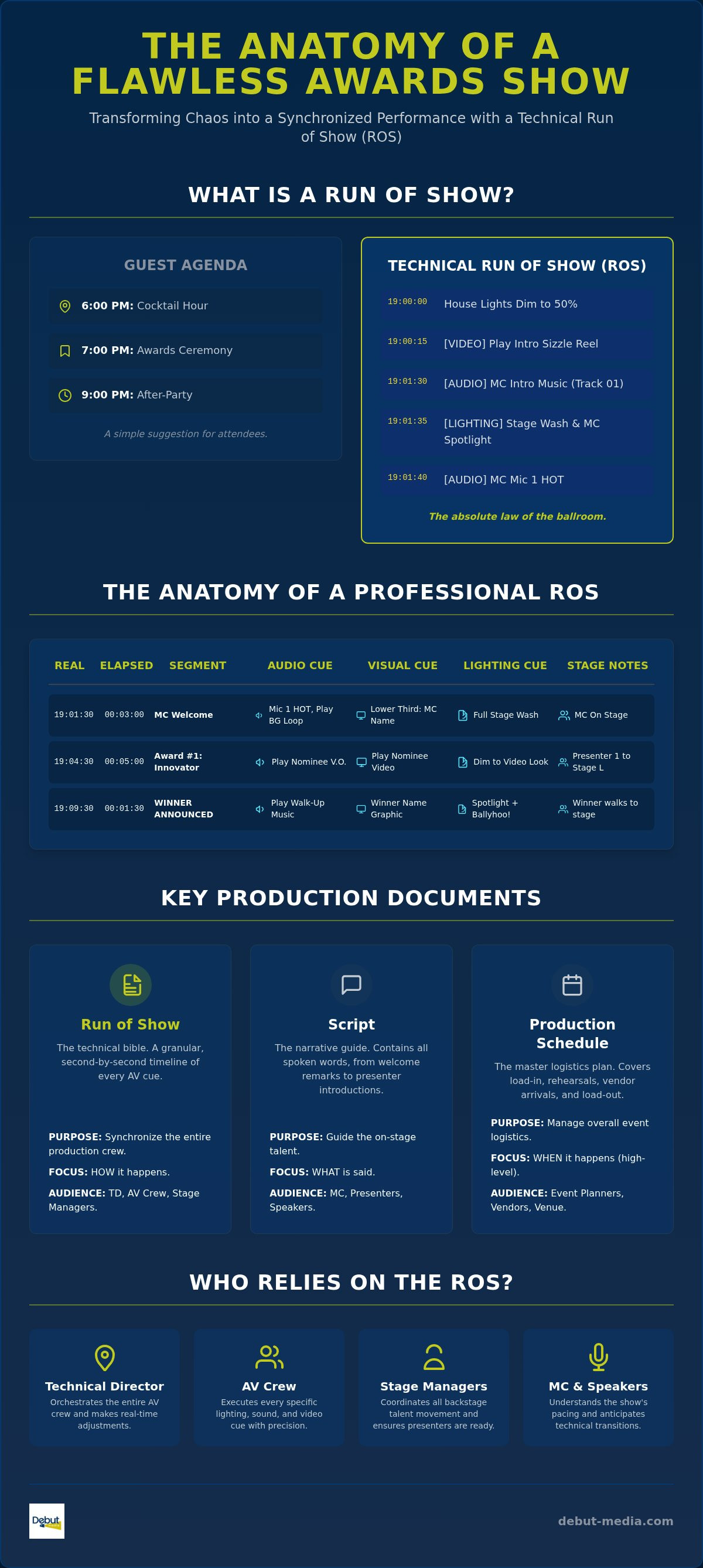
An award show run of show is a granular, minute-by-minute document that serves as the production team's bible. It's the technical bridge between a planner's vision and the actual execution of a live event. While a guest-facing agenda might list "Awards Ceremony: 7:00 PM," a professional award show run of show template breaks that hour into dozens of specific technical cues. It's the law of the room. It dictates exactly when the house lights dim, when the introductory video rolls, and the precise second the MC's microphone goes live.
High-stakes ceremonies can't rely on a basic timeline. A simple schedule lacks the technical accountability required for a multi-vendor team. The ROS acts as the master document for the Technical Director and the entire AV crew, ensuring every department is synchronized. If the sound engineer doesn't know the exact moment a speaker is walking on stage, you risk awkward silence or "dead air" that kills the event's momentum. A standard schedule tells people what's happening; a run of show tells the crew how to make it happen.
The Core Purpose of an Award Show ROS
The primary goal is the elimination of logistical friction. A well-constructed ROS ensures there's zero dead air between award categories. It synchronizes complex lighting transitions with walk-up music and on-screen graphics, creating a polished, broadcast-quality feel. It also provides a vital safety net. If a presenter goes off-script or a video file fails to load, the ROS gives the production team a clear path to get the show back on track without the audience ever noticing a hiccup. It provides the peace of mind that every transition is accounted for.
Who Needs Access to the Run of Show?
Transparency is key to a smooth event. Everyone involved in the execution needs to be on the same page. The following roles rely heavily on the document:
The Technical Director (TD) and AV crew: They use it to hit every lighting, sound, and video cue with precision.
Event planners and stage managers: They use it to coordinate backstage movements, ensuring presenters are "in the wings" at the right time.
The Master of Ceremonies (MC) and keynote speakers: It helps them understand the pacing of the evening and prepares them for the technical transitions happening around them.
By providing a single, cohesive master plan, you replace fragmented communication with a structured framework. This ensures that your technical delivery matches the prestige of the awards being presented.
The Technical Anatomy of a Professional ROS Template
A professional award show run of show template is far more than a simple list of events; it is a multi-dimensional grid designed to track every technical variable in the room simultaneously. To maintain total control, your document must account for both Real Time and Elapsed Time. Real Time tells the crew exactly what time it is on the clock (e.g., 7:15 PM), while Elapsed Time tracks the duration of each segment (e.g., 03:00 minutes). This dual tracking allows the Technical Director to see instantly if the show is running long, providing the data needed to make real-time pacing adjustments without panicking the presenters.
The Segment Column acts as the anchor for the entire document. Every award, speech, or performance needs a clear label so the crew can orient themselves at a glance. Beside this, dedicated columns for Audio, Visual, and Lighting ensure that no department is guessing. Audio cues specify walk-up music and microphone assignments, while Visual columns coordinate on-screen slides and live camera feeds. Lighting cues manage stage washes and the high-energy "ballyhoo" effects used to celebrate winners. This level of detail eliminates the friction that typically leads to technical glitches.
Integrating AV Cues into Your Workflow
Clarity is the primary defense against production errors. When building your award show run of show template, every instruction must be actionable and brief. A technical cue is a specific instruction for an AV operator to trigger a change in the environment. For example, an audio cue should read "Mic 1 hot, fade in track 4" rather than "Start the music." Video playback should be tied to specific verbal triggers from the script, ensuring the visual matches the speaker's words perfectly. If you find these technical layers overwhelming, partnering with a professional team for Audio Visual Services ensures a seasoned hand is managing every cue with precision.
Stage Management and Talent Tracking
The technical booth isn't the only area that needs coordination. Your ROS must include status columns for stage management, specifically tracking "On Stage" versus "Backstage" locations for all talent. This prevents the nightmare scenario of an MC announcing a winner who isn't even in the room. A dedicated row for the "Ready" cue tells the stage manager exactly when to escort the next presenter to the wings. Additionally, tracking the physical location of award trophies and certificates within the ROS ensures that the right hardware is in the right hands at the exact moment the spotlight hits.
Run of Show vs. Script vs. Production Schedule
Precision in event production requires a clear hierarchy of documentation. One of the most common mistakes in gala planning is attempting to jam every piece of information into a single spreadsheet. To maintain a professional environment, you must distinguish between the script, the production schedule, and the award show run of show template. Each document serves a unique user group and addresses a specific facet of the ceremony. Confusing these three pillars often leads to cluttered documents that are impossible for a Technical Director to read during the heat of a live transition.
The Event Script is the "what" of your show. It contains every word spoken by the MC, the presenters, and the keynote speakers. It's a narrative document designed for the talent. While the script might include stage directions, it lacks the granular technical data required by the crew. Conversely, the Production Schedule is the "how" of the event. It covers the logistical heavy lifting, such as load-in times, vendor arrivals, and technical rehearsals. It's about the building of the event, not the minute-by-minute execution of the ceremony itself.
The Run of Show is the "when." It's the technical timing and specific cues that keep the AV crew in sync. Attempting to use a script as a run of show is a recipe for technical failure. Scripts are too wordy for an operator to follow while managing a soundboard or lighting console. A dedicated award show run of show template strips away the fluff, leaving only the actionable triggers that define the show's rhythm.
How the ROS Bridges the Gap
A successful production uses the ROS to translate script highlights into technical reality. Instead of reading three paragraphs of an intro, the AV team sees a single line item: "MC Intro Video - Cue Track 2." This ensures the team knows exactly which script page corresponds to which technical change. By maintaining this single source of technical truth, you reduce logistical friction and ensure that the "front of house" experience for your guests matches the "back of house" efficiency of your crew.
Managing Version Control in 2026
The days of relying on printed binders are over. In 2026, cloud-based live documents are the standard for high-stakes events. Printed copies become obsolete the moment a speaker changes their walk-up song five minutes before doors open. You should establish a "final" deadline for major ROS changes at least 24 hours before the rehearsal to allow the crew to prep. This level of organization is how Debut Media synchronizes with your planning team, ensuring every update is reflected across all technical departments in real time.
Building Your Award Show Template: A Step-by-Step Guide
Constructing a high-stakes production requires a methodical approach that moves from the big picture to the smallest technical detail. Start by mapping the "Skeleton" of your event. This involves inputting the hard start and end times for the gala into your award show run of show template. Once the timeframe is established, you can define segments by breaking the ceremony into logical "blocks" such as the opening sequence, award categories, dinner service, and closing remarks. This structure ensures that the overall flow remains balanced and that no single section overstays its welcome.
After the blocks are set, you must layer in the technical cues. This is a collaborative phase where you work with your AV partner to add specific sound, video, and light details for every line item. Testing these cues is the next critical step. Conduct a thorough technical walkthrough to verify every trigger against the script, ensuring the visual on the screen matches the words spoken on stage. Finally, execute a full dress rehearsal. Running the ROS in real-time with full production allows the team to feel the show's rhythm and identify any lingering friction before the first guest arrives.
Pre-Show and Post-Show Logistics
A professional production guide accounts for the moments before and after the spotlight is on. You should include "Doors Open" and "Background Music" as formal line items in your award show run of show template to ensure the atmosphere is set correctly from the start. Logistics don't end with the final applause. Planning for event equipment strike services ensures a clean and efficient venue exit, preventing overtime fees or lost gear. Scheduling a post-show debrief while the crew is still on-site allows you to capture immediate feedback and document successes while the details are fresh.
Contingency Planning in the Template
Stability comes from preparing for the unexpected. Your template should feature dedicated "Fill" segments to account for long acceptance speeches or unexpected delays. An "Emergency Slide" cue provides the Technical Director with a professional visual buffer if a technical reset is required. Additionally, your ROS should include a plan for handling no-show presenters. By having a pre-determined skip logic, the MC can transition to the next segment without the audience ever sensing a break in the show's momentum.
Ready to bring your vision to life with expert oversight? Partner with Debut Media for comprehensive Event Management and professional production services that guarantee a seamless execution.
Why Professional Production Outperforms a DIY Template
An award show run of show template provides the map, but you still need a seasoned pilot to fly the plane. While a spreadsheet organizes your thoughts, professional production turns those cells into a sensory experience. The true value of expert oversight lies in the transition from a static document to a dynamic live event. Professional Technical Directors live inside the ROS, managing every micro-adjustment so you don't have to worry about a single missed beat. They anticipate the "what-ifs" before they become "oh-nos," providing a level of stability that a DIY template simply cannot offer.
Precision is especially critical when integrating high-end stage lighting for galas. A "ballyhoo" or a "sting" isn't just a flashy effect; it's a programmed response triggered by a specific line in your ROS. When these elements are managed by an in-house technical crew, the synchronization is flawless. This synergy between the document and the hardware creates the polished, high-stakes atmosphere your honorees deserve. It moves the event away from a transactional feel toward a partnership-based approach where every detail is handled with expert care.
Eliminating Logistical Friction
The most significant relief for an event planner is having a single point of contact for both AV and management. Integrated production reduces the need for multiple, fragmented vendors who might misinterpret your cues. You gain the confidence of knowing every audio sting and lighting wash is pre-programmed and tested. Debut Media handles the entire technical operation, allowing you to focus on your VIPs and the guest experience rather than the soundboard. This shift from managing parts to overseeing a partnership is the hallmark of a successful 2026 ceremony.
Ready to Execute Your Award Show?
Building a professional award show run of show template is the first step toward a stress-free event. However, leveraging professional equipment rentals and consulting with production experts during the planning phase ensures your template is grounded in technical reality. Our team acts as a stabilizing force, turning complex logistics into a cohesive master plan. If you're ready to elevate your ceremony, contact Debut Media for professional award show production today. We provide the expertise needed to transform your vision into a seamless live experience.
Master Your Next High-Stakes Ceremony
A successful gala depends on the bridge between your creative vision and technical reality. By implementing a professional award show run of show template, you replace uncertainty with a structured framework that keeps every lighting cue and audio sting in perfect sync. You now understand how to separate your narrative script from your technical cues and why a minute-by-minute timeline is the only way to eliminate dead air during live transitions. This level of organization ensures that the "back of house" efficiency matches the "front of house" prestige.
While the template provides the structure, expert execution provides the peace of mind you need on show day. Debut Media offers comprehensive gala and award show production services, acting as your single point of contact for all event logistics. From expert AV equipment rentals and on-site technical support to full event management, we ensure your production remains a stabilizing force in a complex environment. It's time to streamline your next production with Debut Media and focus on celebrating your honorees while we handle the technical heavy lifting. Your next seamless event is within reach.
Frequently Asked Questions
What is the most important column in an award show run of show?
The technical cues column is the most critical element because it translates your vision into actionable steps for the AV crew. This section includes specific triggers for lighting, sound, and video playback. Without these clear instructions, the production team is left guessing when to hit a "ballyhoo" or fade a microphone. A professional award show run of show template ensures every operator knows exactly which trigger corresponds to the action on stage.
How detailed should a corporate gala run of show be?
Your document should be minute-by-minute to ensure total control over the event's pacing. For high-stakes transitions, such as the announcement of a major winner, the detail often drills down to the second. You must account for walk-up times, trophy handoffs, and background music fades. This level of granularity eliminates dead air and prevents the logistical friction that occurs when transitions are left to chance or vague verbal cues.
Can I use a standard Excel sheet for my run of show template?
You can use a standard Excel sheet, but cloud-based platforms are preferred in 2026. These tools provide real-time updates and version control, which are vital when last-minute script changes occur. If you use a static file, you risk the crew operating off an outdated version. A robust award show run of show template works best when it serves as a live, synchronized master document for the entire technical team.
What is the difference between a run of show and a production cue sheet?
The run of show is the master timeline for the entire production, while a cue sheet is a department-specific breakdown. A lighting cue sheet only lists the light changes, whereas the ROS provides context by showing how those lights sync with audio and stage movements. The ROS acts as the singular source of truth that keeps the Technical Director and every individual operator working in perfect harmony throughout the ceremony.
How do I handle acceptance speeches that go over time in the ROS?
You should build "buffer" segments or flexible "fill" time into your schedule to accommodate long speeches. If a winner exceeds their allotted time, the Technical Director can use these pre-planned blocks to adjust the remaining segments without cutting the closing remarks short. It's also helpful to have "emergency music" or a background loop ready in the ROS to gently signal to the speaker that their time has ended.
Who is responsible for managing the run of show during the live event?
The Technical Director is the primary person responsible for calling the show based on the ROS. They sit in the production booth and communicate cues to the lighting, sound, and video operators via headset. While the event planner focuses on the VIPs and guest needs, the Technical Director ensures the technical execution remains flawless. This separation of duties allows the production to run smoothly while the planner handles high-level logistics.
When should the final version of the run of show be locked?
You should lock the final version of the document at least 24 hours before the technical rehearsal. This window gives the AV crew time to program lighting consoles, prepare video playback files, and assign microphone channels. While minor adjustments often happen during the dress rehearsal, the core structure must be finalized early to prevent technical glitches and ensure the team has a stable plan to execute on show day.
How does the run of show change for virtual or hybrid award shows?
Virtual and hybrid shows require additional columns for digital cues, such as "Stream Start," "Virtual Speaker Link," and "Chat Moderation." You must coordinate the in-room experience with the online broadcast, often managing two different "front of house" perspectives simultaneously. The ROS becomes the bridge that ensures both the physical audience and the remote viewers see and hear the same polished production at the exact same moment.


