
Corporate Event Logistics Management: A Strategic Guide to Seamless Execution in 2026
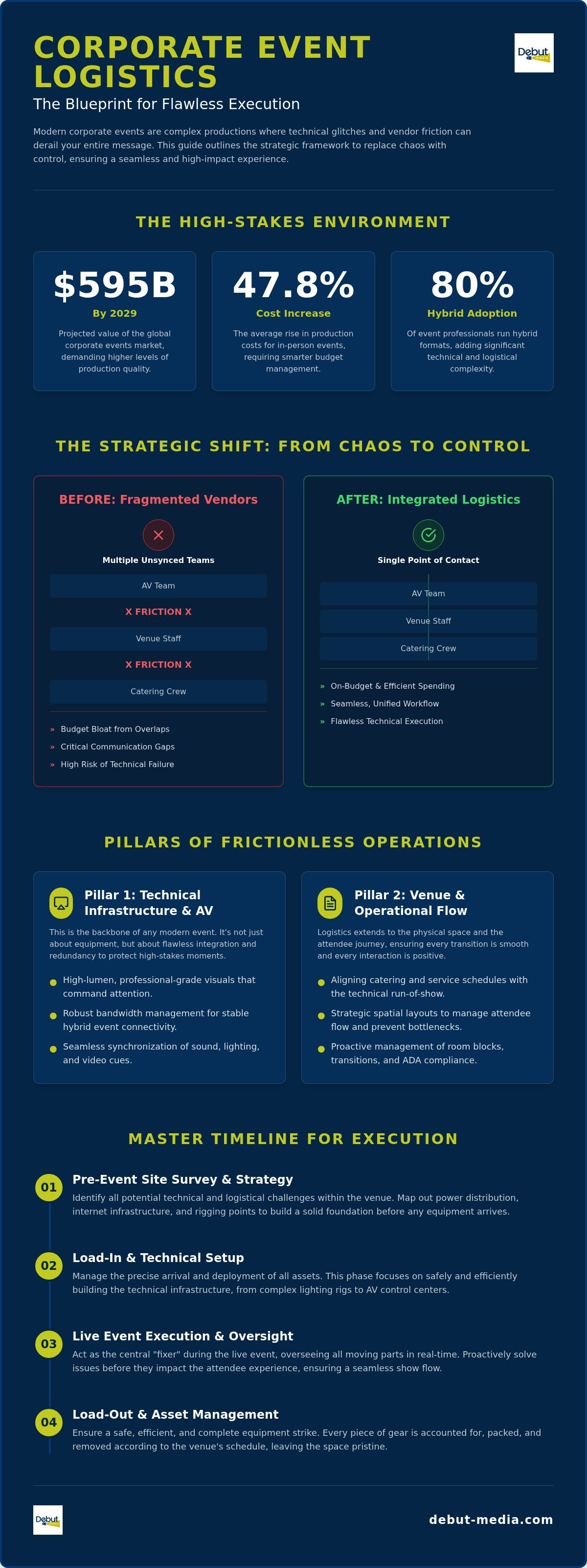
What if the most significant risk to your next conference isn't the content, but the invisible friction between your technical team and your venue staff? With the global corporate events market projected to reach $595 billion by 2029, the scale of these productions is growing faster than most internal teams can handle. Effective corporate event logistics management has become more than just a checklist; it's the stabilizing force that prevents technical glitches from overshadowing your message. We understand the frustration of managing fragmented vendors and the budget bloat that often follows when services aren't integrated.
You deserve a strategy that replaces chaos with a single, authoritative point of contact. This guide provides the framework to master complex operations by merging technical production and logistical oversight into one seamless flow. We'll break down how to manage the 47.8% rise in production costs for in-person events while ensuring flawless execution through expert oversight. By the end of this article, you'll have a clear roadmap to eliminate logistical friction and reclaim your peace of mind.
Table of Contents
Defining Corporate Event Logistics Management: Beyond Transportation
Many professionals mistake logistics for simple transportation or venue booking. In reality, modern corporate event logistics management is the strategic synchronization of people, technology, and venue operations. It is the invisible engine that powers your message. While planning focuses on the "what" of an event, such as the theme or the speaker lineup, logistics focuses on the "how." It's the difference between having a great idea and actually executing it without a single hitch.
In 2026, the complexity of these operations has shifted. Events now require higher technological redundancy than ever before. With 80% of event professionals now running hybrid formats as a permanent part of their strategy, a single internet outage or a failed server can disconnect half your audience. Logistics ensures there's a backup for every critical system. Most event failures happen at the friction points where different vendors overlap. When the AV crew and the venue staff don't communicate, your keynote starts late. This is where specialized Event management becomes a logistical discipline. It's about removing silos and creating a unified workflow that protects your investment.
The Core Components of Modern Event Logistics
Technical infrastructure: This involves managing high-end AV services, complex lighting rigs, and the digital connectivity required for thousands of attendee devices.
Operational flow: We analyze how attendees move through a space, the precise timing of catering services, and the seconds between speaker transitions to maintain momentum.
Asset management: This covers the entire lifecycle of physical equipment. It starts at the first truck arrival for load-in and continues through the final equipment strike, ensuring every piece of gear is handled with precision.
Why Logistics Determines Your Event ROI
Expert corporate event logistics management directly impacts your bottom line by eliminating the hidden costs of inefficiency. When you reduce downtime through expert technical operation, you maximize the value of every minute your attendees are engaged. You also stop the budget leaks that occur when fragmented vendors charge for overlapping services or fixable errors. Logistical ROI is the ratio of seamless execution to total resource spend. When you eliminate the cost of mistakes, your event's actual value increases. By positioning a single point of contact to oversee these moving parts, you transform a series of transactions into a cohesive, high-performing partnership.
The Four Pillars of Frictionless Event Operations
Successful corporate event logistics management relies on four foundational pillars. These aren't independent silos; they're interconnected systems that must work in harmony to prevent the technical glitches or budget bloat that often plague large-scale productions. When one pillar is weak, friction ripples through the entire event, distracting your audience from your message. Our approach focuses on unifying these elements to provide a single, stabilizing point of oversight for your entire team.
Pillar 1: Technical Infrastructure and AV
High-stakes keynotes depend on perfect synchronization between sound, video, and the venue's physical constraints. In 2026, presentations require crisp, high-lumen visuals that stay vibrant even in well-lit rooms. Utilizing a professional projector rental ensures your visual content matches the quality of your brand, regardless of the venue's existing equipment. We also manage the increased bandwidth demands of modern hybrid components, ensuring digital connectivity remains stable when remote audiences and on-site presenters interact in real-time.
Pillar 2: Venue and Catering Coordination
Venue logistics involve more than just booking a room. It requires aligning the catering service with the technical run-of-show. You don't want the clatter of a lunch clearing to drown out a sensitive panel discussion or a CEO's closing remarks. We manage spatial layouts to maximize attendee flow while ensuring ADA compliance and accessibility are baked into the plan. This proactive oversight ensures every attendee has an equitable and comfortable experience without any logistical hurdles. Managing room blocks and spatial transitions effectively prevents the "bottleneck" effect during peak transition times.
The third pillar, attendee experience, begins the moment a guest registers. Frictionless on-site check-in sets a positive emotional tone for the entire day, allowing guests to focus on networking rather than paperwork. Finally, a robust communication strategy keeps the crew and stakeholders in perfect sync. We use real-time communication channels to manage every moving part, acting as the "fixer" who handles adjustments before they become visible problems. If you're looking for this level of integration, our Event Management services are designed to consolidate these pillars into a single, stress-free operation.
The Strategic Shift: Consolidating Multiple Event Vendors
Many organizations believe that hiring separate "best-of-breed" vendors for every individual task ensures higher quality. This is often a costly misconception. In reality, managing three or four different teams creates massive communication overhead and dangerous technical gaps. When your AV team, stage manager, and logistics coordinator operate in silos, you face the risks of multiple event vendors, where no single entity is responsible for the overall outcome. Consolidating these roles into a single point of contact simplifies corporate event logistics management and provides a stabilizing force for your entire production.
The Myth of Specialized Silos
Integrated production teams consistently outperform fragmented groups because they share a unified vision and a single communication channel. Consider a scenario where an independent lighting vendor doesn't know the exact dimensions of the projection screen provided by the AV vendor. The result is often a washed-out image during a high-stakes keynote because the lights weren't positioned for the specific screen gain. An integrated team catches these discrepancies during the initial site survey, not ten minutes before the doors open. This level of synchronization eliminates the "blame game" that occurs when technical glitches happen.
Centralized project management also simplifies your corporate accounting. Instead of tracking dozens of separate invoices with conflicting payment terms, you receive a single, transparent billing statement. This reduces administrative friction and allows your finance team to track the total event spend with precision. It's a cleaner, more professional way to handle the complex financial moving parts of a large-scale seminar or conference.
Efficiency Gains in the Planning Phase
Meeting fatigue is a real threat to internal productivity. When you work with a single production partner, you eliminate the need for redundant status calls and endless email threads between different service providers. This consolidation frees up your internal resources to focus on high-level strategy and attendee engagement rather than refereeing vendor disputes. Decision-making moves faster when you aren't waiting for four different companies to coordinate their schedules for a simple update.
To maintain clarity throughout this process, we utilize a conference planning and management checklist for unified tracking. This ensures that every stakeholder has a real-time view of the project's progress. By using a single partner who acts as a "fixer," you gain an authoritative guide who has a plan for every possible scenario. This approach transforms corporate event logistics management from a stressful burden into a streamlined, predictable process that guarantees flawless execution.
A Master Timeline for Logistical Execution
Execution is the visible result of months of preparation. In 2026, booking lead times for major convention venues have stretched to 18 or 24 months, making the early planning stages more critical than ever. Successful corporate event logistics management requires a phased approach that treats the final equipment strike with the same level of precision as the opening keynote. By following a methodical timeline, you eliminate the "panic mode" that often occurs during the final 48 hours of production.
The Pre-Event Technical Deep-Dive
The first phase focuses on verification. We conduct comprehensive site surveys to identify physical limitations that could derail your technical plans. This includes checking power availability, ceiling rigging points, and potential Wi-Fi dead zones that could affect your hybrid event components. Once the physical environment is mapped, we finalize the run-of-show with all technical leads to ensure every transition is accounted for. Technical rehearsals serve as the final verification that every integrated system responds correctly under live conditions. These rehearsals allow us to calibrate sound levels and visual cues, ensuring your presenters feel confident and supported the moment they step onto the stage.
Execution and Post-Event Strike
Phase two and three involve the physical load-in and live operation. During load-in, we establish the technical foundation, setting up AV, lighting, and digital infrastructure before the first attendee arrives. Once the event begins, our in-house technical crew monitors every system in real-time. We act as the "fixer" behind the scenes, handling adjustments and troubleshooting before they become visible to your audience. This proactive oversight is what keeps a high-stakes gala or conference running smoothly.
The final phase, the equipment strike, is often overlooked by less experienced providers. This is the efficient removal of all assets and the formal handover of the venue. A chaotic strike can lead to venue damage or lost equipment, which bloat your final budget. We manage this process with military precision, ensuring the space is cleared quickly and professionally. After the strike, we conduct a logistical debriefing to review performance and asset management. If you need a partner who handles every phase from the initial survey to the final strike, explore our Event Management services to see how we can streamline your next production.
Effective corporate event logistics management doesn't end when the last speaker leaves the stage. It ends when the venue is restored and every piece of technical gear is accounted for. This full-lifecycle approach provides the reliability and peace of mind necessary for modern corporate environments.
Partnering with Debut Media for Turnkey Success
Mastering corporate event logistics management requires more than just a detailed plan; it requires a partner who can execute that plan with surgical precision. Debut Media acts as your dedicated "fixer," taking ownership of every technical and operational detail so you don't have to. We replace the stress of managing fragmented vendors with the security of a single, professional point of contact. Our team provides the stabilizing force needed to turn a complex production into a seamless experience for your attendees and stakeholders. We understand that your reputation is on the line with every keynote and transition.
Our strength lies in our integrated model. Unlike agencies that outsource their core services to third parties, we maintain an extensive in-house inventory of equipment and a dedicated technical crew. This ensures that the person you speak with during the planning phase is directly connected to the team executing on-site. Our nationwide reach allows us to maintain consistency across multiple event locations, ensuring your brand standards are met every time. We don't just provide equipment; we provide the expertise to manage it within the unique constraints of any venue, eliminating the friction that typically leads to technical glitches or budget overruns.
Our Comprehensive Service Suite
Audio Visual Services: We provide full-scale production for seminars, conferences, and high-stakes galas, ensuring your message is delivered with absolute clarity.
Trade Show & Expo Support: Our team manages specialized lighting and graphics to help your brand stand out in busy exhibition environments while handling rapid setup and strike.
Projector and Screen Rentals: We offer high-quality visual solutions tailored to the specific dimensions and ambient lighting of your chosen venue.
End-to-End Event Management: From the initial site survey to the final equipment strike, we provide expert oversight of every moving part to ensure a flawless run-of-show.
Ready to Simplify Your Next Event?
The transition from a stressed planner to a confident host begins with a single decision. We offer comprehensive logistical consultations to identify potential hurdles before they impact your event. By customizing our production services to fit your specific business goals, we ensure your resources are used efficiently and effectively. When you step into the venue, you should be able to focus on your guests while we handle the foundation. You move from managing a crisis to hosting a success. Contact Debut Media today to start planning your frictionless corporate event and experience the peace of mind that comes from professional oversight.
Securing Your Event's Success through Integrated Strategy
Executing a high-stakes corporate event in 2026 requires more than a vision; it demands a flawlessly synchronized operational engine. Effective corporate event logistics management is built on the seamless integration of technical production and venue coordination. By moving away from fragmented vendor silos and adopting a phased execution timeline, you eliminate the risk of technical glitches and budget bloat. This strategic shift transforms your role from a stressed coordinator into a confident host who can focus on your message rather than the machinery.
At Debut Media, we provide turnkey AV and logistics solutions that act as a stabilizing force for your production. Our in-house technical production experts and single point of contact model ensure every moving part is managed with precision across seminars, conferences, and galas nationwide. You don't have to navigate the complexities of modern event production alone. We're here to serve as your authoritative guide and "fixer" for every logistical challenge that may arise.
Streamline your next event with Debut Media's production services and reclaim your peace of mind. Let's work together to create an experience that is as frictionless as it is memorable.
Frequently Asked Questions
What is the difference between event planning and event logistics?
Event planning focuses on the high level strategy and creative vision, such as defining the theme, selecting speakers, and designing the program content. Logistics is the technical execution and operational synchronization required to bring that vision to life. While a planner decides what will happen, the logistics team manages the how, including technical production, attendee flow, and vendor coordination.
Why should I use a single vendor for my corporate event production?
Consolidating your needs under a single partner eliminates the communication gaps and technical friction that occur when multiple siloed vendors overlap. A single point of contact acts as a "fixer" who takes full accountability for the entire production. This model reduces administrative overhead, prevents "blame games" during technical glitches, and ensures that every piece of equipment works in harmony with the venue's constraints.
What are the most common logistical failures at corporate events?
Most failures occur at the friction points between different service providers, such as misaligned AV and lighting or catering schedules that disrupt the technical run of show. Technical glitches during high stakes keynotes and chaotic equipment strikes are also frequent hurdles. These issues usually stem from a lack of centralized oversight and insufficient pre event site surveys.
How do I manage logistics for a hybrid or virtual event?
Effective corporate event logistics management for hybrid formats requires a heavy focus on digital infrastructure and technical redundancy. You must manage high speed bandwidth, secondary failover internet lines, and the synchronization of remote and local feeds. The goal is to ensure that the experience for virtual attendees is just as stable and engaging as it is for those on site.
When should I start the logistical planning process for a large conference?
You should begin the logistical deep dive as soon as your venue is secured, which often happens 18 to 24 months in advance for large scale conventions. Once the venue is locked, start technical site surveys immediately to identify power and rigging limitations. Early planning allows for the necessary technical rehearsals that prevent surprises during the live event.
What does 'equipment strike' involve in event management?
An equipment strike is the systematic removal of all AV gear, lighting rigs, and physical assets immediately following the conclusion of an event. This process must be handled with precision to ensure the venue is returned in its original condition without damage. Professional corporate event logistics management treats the strike as a critical final phase, including asset tracking and a final logistical debrief.
How can I reduce logistical friction between the venue and my AV team?
The best way to reduce friction is to conduct early, collaborative site surveys with both the venue staff and your technical leads present. This allows everyone to verify power requirements, loading dock access, and rigging points before the load in begins. Having a single point of contact to manage these relationships ensures that everyone is working from the same master timeline.
What technical redundancy should I have in place for my event?
You should have fail safes for every mission critical system, including backup projectors, secondary audio consoles, and uninterruptible power supplies. For hybrid events, this also includes having a secondary streaming platform ready to go. Redundancy provides the peace of mind that a single hardware failure won't derail your entire presentation or disconnect your audience.


