Questions to Ask Your Event AV Provider: The 2026 Vetting Checklist
Updated: Oct 4

The best AV partners act as proactive production coordinators, not just equipment rental houses. Knowing the right questions to ask your event AV provider can make the bidding process clear and stress-free. You should not have to decipher complex rental items, worry about technical issues during keynotes, or face surprise invoices for rigging and overtime.
This 2026 vetting checklist provides the essential technical, staffing, and pricing questions to confidently select the right AV provider. It offers a practical framework to objectively compare vendor quotes, verify on-site engineering expertise, and ensure transparency in production logistics before signing a contract.
Table of Contents
Technical Capability Questions: Vetting Event Audio Visual Hardware and Infrastructure
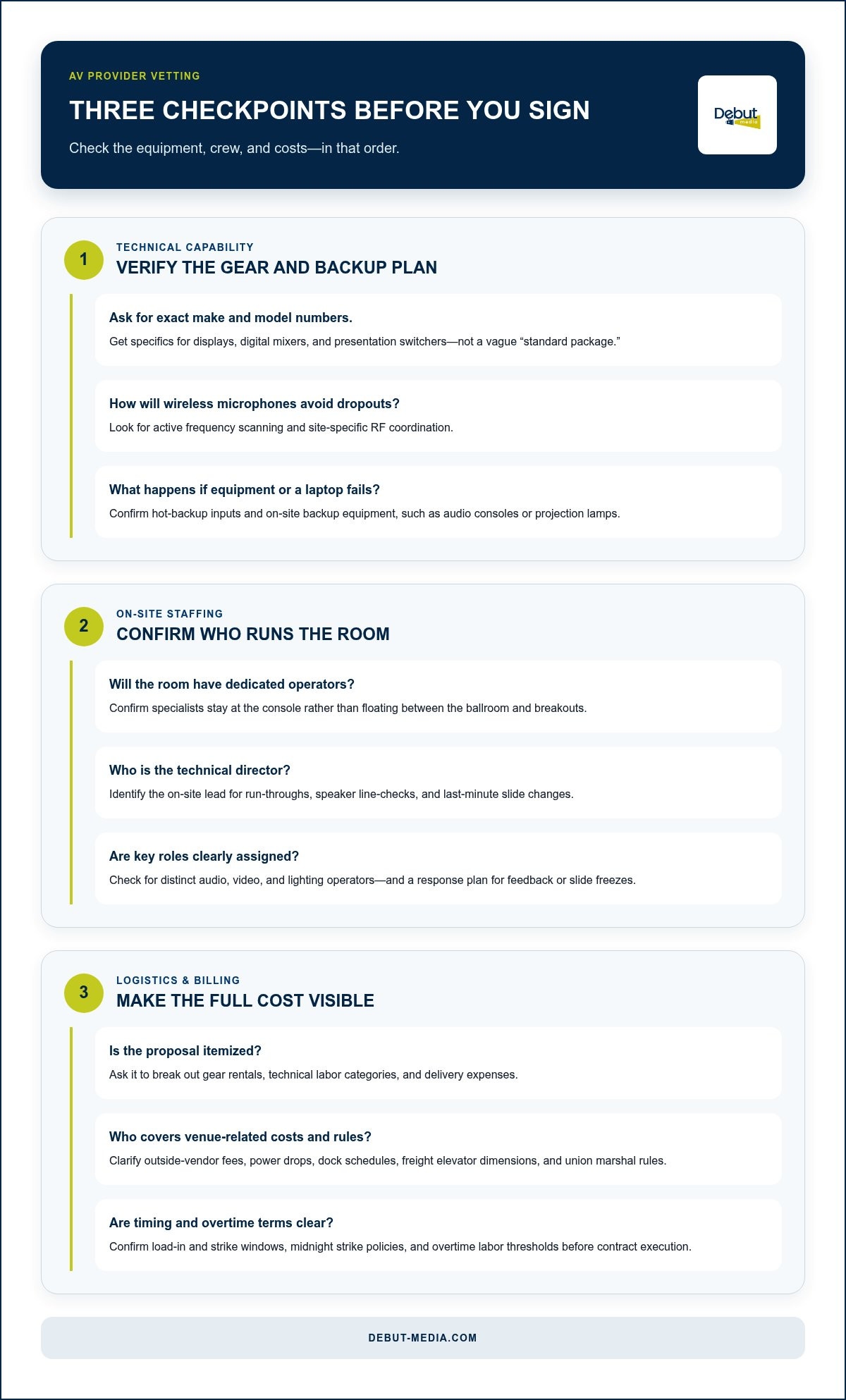
Vague quotes often hide aging gear. When compiling the essential questions to ask your event AV provider, demand exact make and model numbers for displays, digital mixers, and presentation switchers rather than accepting broad descriptions like "standard projector package." You need to know how the team handles signal flow across core audiovisual components.
Listen carefully to how prospective vendors respond to these critical technical checks:
Gear Inventory: A poor answer is, "We provide whatever is available in the warehouse that week." A good answer specifies exact, modern hardware, such as networked Dante digital consoles and high-lumen laser projection.
RF Frequency Coordination: Inquire how wireless microphones will avoid dropouts in congested RF environments. A qualified partner uses active frequency scanning and site-specific RF coordination rather than just turning units on and hoping for clean channels.
Switching and Signal Redundancy: Confirm what happens if a keynote presenter's laptop freezes. Reliable teams run seamless switchers with hot-backup inputs ready to take over instantly.
Evaluating Redundancy Plans and Venue Technical Site Surveys
Equipment failures occur when contingency planning is neglected. Ensure the company provides backup audio consoles, project lamps, or secondary lenses on site. Experienced providers conduct technical walk-throughs to assess rigging limits and power drops. Partnering with comprehensive audio visual services allows for complete acoustic profiling before load-in, preventing technical issues before attendees arrive.
On-Site Staffing Questions: Evaluating Technical Crew and Live Operations
Hardware reliability depends on the expertise of the control board operators. To ensure your stage crew has the necessary experience for live corporate events, ask your event AV provider if your general session has dedicated room operators or shared floating technicians. Be cautious if they say, "One technician will float between your ballroom and breakouts." A dependable partner provides dedicated specialists at the console for the entire event.
An on-site leader is crucial. Inquire about your direct technical director during run-throughs for managing speaker line-checks and last-minute slide changes. To avoid managing separate freelancers, consider Debut Media AV and Production for a unified crew and a single point of contact for show execution.
Confirming Operator Roles and Glitch Mitigation Protocols
For high-stakes presentations, ensure separate operators for audio, video, and lighting: an audio engineer for lavaliers, a video operator for presentations, and a lighting technician for stage wash. Verify their documented response plans for issues like microphone feedback or slide freezes. Rehearsed protocols quickly address technical glitches, preventing audience awareness.
Logistics and Billing Questions: Eliminating Hidden Fees and Vendor Friction
Unexpected post-event invoices often result from unclear logistical terms. Ensure transparent pricing by requesting an itemized proposal detailing gear rentals, technical labor, and delivery costs. When questioning your event AV provider, consider potential venue interface charges beyond equipment line items.
Clarify these operational checkpoints upfront to avoid unexpected venue surcharges:
Facility Easements and Patch Fees: Ask how the production team interfaces with in-house house sound systems and venue power drops, confirming who absorbs any venue outside-vendor access fees.
Dock Access and Freight Routing: Inquire about loading dock schedules, freight elevator dimensions, and union marshal rules to make sure gear transport proceeds smoothly.
Load-In and Strike Windows: Confirm setup timelines and midnight strike policies to avoid steep facility penalty rates for occupying ballrooms past scheduled contract hours.
Protecting Budgets Through Unified Production and Logistics Management
Fragmented communication among third parties causes operational friction. Ensuring your production crew uses a single point of contact stabilizes the budget. Integrating professional corporate event logistics management aligns load-in schedules, technical checks, and catering. Verify overtime labor thresholds before signing contracts to avoid unexpected staffing costs for extended events.
Take Control of Your Next Production Contract
Ensuring a flawless corporate conference involves asking the right questions well before the event day. By equipping your planning team with specific questions for your event AV provider, you replace technical uncertainty with complete operational clarity.
This approach allows you to confirm gear redundancy ahead of time, secure dedicated on-site engineers for your main session, and avoid unexpected dock or power fees before they impact your budget. Throughout Raleigh, Durham, and Chapel Hill, collaborating with a comprehensive production specialist provides an experienced technical director who manages every audio, video, and lighting cue through a single, accountable contact.
Provide your keynote speakers with full technical assurance and grant your organization complete peace of mind from rehearsals to the final teardown.
Frequently Asked Questions
What is the most important question to ask an event AV provider?
The single most critical inquiry among the questions to ask your event AV provider is whether they provide a dedicated on-site technical director and hot-backup equipment. Gear matters, but an experienced technical lead who oversees signal flow and rehearsal troubleshooting protects your brand from live presentation glitches far better than unmanaged rental hardware ever could.
How far in advance should I hire an AV provider for a corporate conference?
You should contract your AV production partner three to six months before your event. Early booking ensures preferred hardware availability, reserves dedicated senior crew, and allows sufficient lead time for venue walk-throughs across Raleigh, Durham, and Chapel Hill properties. Early engagement also helps your team navigate outside vendor policies and dock reservation windows well before opening remarks.
What is the difference between an in-house hotel AV team and an outside provider?
Hotel in-house teams are often bound to fixed facility equipment and generalist staff, frequently passing along significant commission markups. An independent production partner delivers customized gear packages, dedicated room engineers, and complete pricing transparency. Independent providers act as your personal advocate, coordinating every technical cue and managing room turnarounds under a reliable single point of contact.
Can an independent AV company handle logistics at local conference centers?
Yes, established independent providers routinely coordinate dock access, freight elevators, and venue power drops at major regional meeting venues. When vetting candidate questions to ask your event AV provider, confirm their familiarity with Triangle corporate spaces. A partner with local venue experience easily coordinates house audio patches and facility regulations, preventing logistical delays during setup.